Leaders promise to improve China's air quality
Government plans to promote clean energy, rigorously monitor pollution
China will set higher anti-pollution standards and implement stricter measures to achieve better air quality, Vice-Minister of Environmental Protection Li Ganjie pledged on Wednesday at a celebration of World Environment Day.
Current measures undertaken illustrated by Li include eliminating outmoded production capacity, promoting clean energy and enhancing comprehensive management and control. They also include setting up warning systems to monitor and forecast smog and hazy weather, perfecting trans-regional prevention and control to combat airborne pollution, and encouraging the public to use resources in a green manner.
 |
|
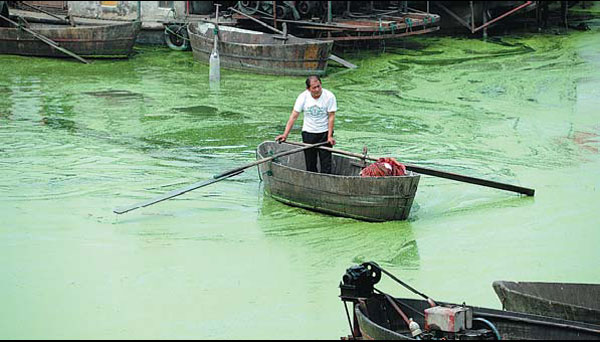
A fisherman rows a boat on the Chaohu Lake in Hefei, Anhui province, on Tuesday. Part of the lake is covered by algae because of pollution. Liu Junxi / Xinhua |
China's environmental conditions in 2012 remained stable, as total emissions from four key environmental indicators continued to drop, but the outlook ahead is still grave, according to the ministry's 2012 Environmental Conditions Report, issued on Tuesday.
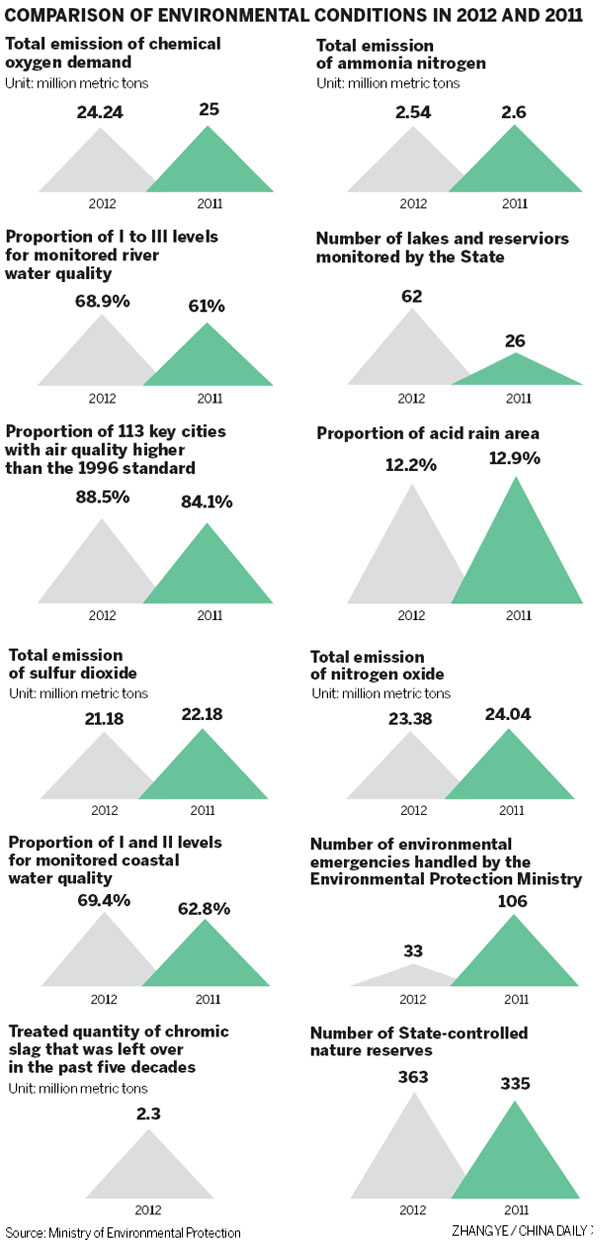
The report said emissions of chemical oxygen demand, a measure of organic pollutants in water, is 3.05 percent less than the 2011 level. Emissions of ammonia nitrogen, another major pollutant in water that threatens some aquatic organisms, dropped 2.62 percent.
The report also noted a decrease of 4.52 percent in the country's total emissions of sulfur dioxide, a major air pollutant, and a fall of 2.77 percent in nitrogen oxide emissions compared with 2011.
The last indicator, nitrogen oxide, an airborne pollutant that comes mainly from motor vehicles in big cities, should drop by 10 percent in 2015 based on the 2010 level as planned. But last year, rather than going down, its emissions increased by almost 6 percent from the 2010 level.
National water conditions made a slight improvement, according to the report. Out of the total 469 State-controlled monitoring sites on 10 main water systems, the proportion of water qualified to be used as drinking-water sources increased from 61 percent in 2011 to 68.9 percent in 2012.
As to heavy metal pollution, about 2.3 million metric tons of chromic slag that was left over in the past five decades was treated in 2012, marking the end of work that began in 2005 to treat about 6.7 million metric tons of industrial waste.
As water pollution gradually increased in rural areas with the advent of urbanization and modernization of farming, all levels of government spent a total of more than 43 billion yuan ($7.01 billion) in 2012 to build safe drinking-water facilities in rural China - 12 billion yuan more than in 2011 - solving water problems for 77 million people.
The report also said another 5.5 billion yuan from the central government was spent to improve the environment in rural areas, including the processing of domestic garbage.
China's top leaders at the 18th National Congress of the Party in November said that building an ecological civilization will be integrated into politics, culture and the economy.
A national action plan corresponding to the United Nations Decade on Biodiversity was issued in June 2012 during the first conference of the China Biodiversity Conservation National Committee, hosted by then-vice premier Li Keqiang.
All 363 State-controlled nature reserves by 2012 are monitored by environmental satellites, so that illegal tourism development or construction within the reserves can be spotted and supervision departments can take further action. Such remote monitoring activity covered only 230 nature reserves in 2011.
The biggest environmental issue in the past year has been airborne pollution. Based on the air quality standard issued in 1996, more than 91 percent of the 325 cities met the standard in 2012, higher than the 89 percent in 2011.
But the passing rate would be less than 41 percent if the nation's updated standard, currently scheduled to take effect in 2016, were adopted to evaluate air quality today.
The new standard, issued in February 2012, set three more indicators to assess air quality in addition to sulfur dioxide, nitrogen dioxide and particulate matter: fine particulate matter, carbon monoxide and ozone.
Readings of these six indicators from about 500 monitoring sites in 74 cities have been made public since January. The new standard will be implemented nationwide on Jan 1, 2016.
The international theme of the 2013 World Environment Day is "think, eat, save". Considering the country's most urgent priority is pollution control, the national theme is set as "breathe the same air, work hard together", as Premier Li Keqiang said during his first meeting with reporters in March.
"Since we breathe the same air, we should work hard together," Li said when answering a question about airborne pollution.