Holding back the sands of time
Desert dwellers are slowly reclaiming cultivatable land, as Cui Jia and Mao Weihua report from Hotan, Xinjiang Uygur autonomous region.
Hotan prefecture in the southwest of the Xinjiang Uygur autonomous region is famous for two things: jade and sand. The locals still try to pluck the precious stones from the dry bed of the Yurungkash River, also known as the White Jade River, but the rising value of jade means the place has almost been picked clean after repeated treasure hunts, so the chances of making new discoveries are slim. However, in this area bordering the Taklimakan, the world's second-largest desert, the sand will never disappear.
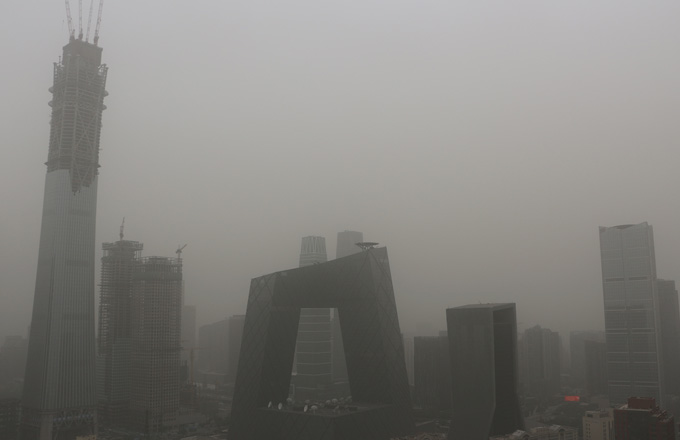
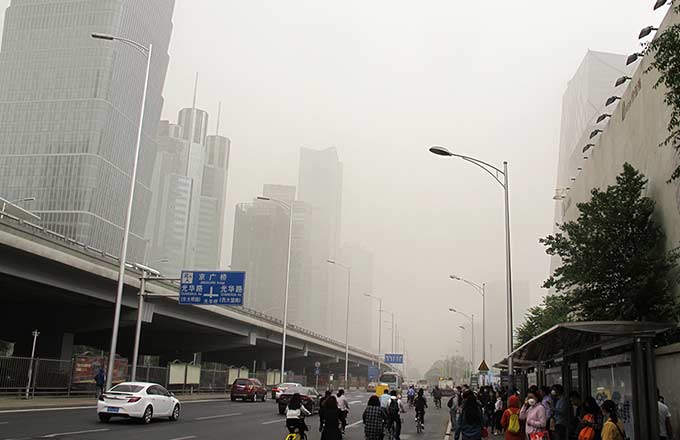
Almost every one in Hotan lives close to the more than 300 oases, large and small, that are dotted around the southern edge of the Taklimakan. Those enclosed by the desert only account for 3.7 percent of Hotan's total area. As a result, people have to cope with windborne sand for more than 260 days a year. On a bad day, they have to be prepared to seek cover from sandstorms, which can blacken the sky within minutes and without warning. In addition to the health problems posed by the storms, sand carried at high speed can erode buildings and strip the paintwork from vehicles.
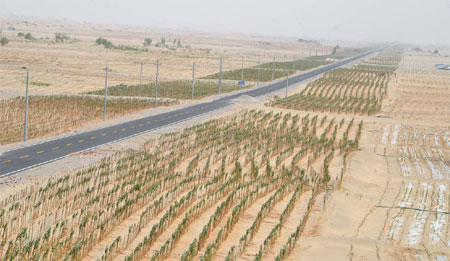 |
| A new artificial greenbelt in Hotan county in the Xinjiang Uygur autonomous region. Photos by Mao Weihua / China Daily |
In Hotan, the transition between oases, fed by the floodwater from northern Hotan's Kunlun Mountains, and the desert is almost instantaneous. One minute the scenery along the road is pure yellow desert and the next, tall poplar trees on both sides of the road suddenly begin to provide comfortable shade from the searing heat.
"At the current rate, the prefecture has been losing 33 square kilometers of oases every year, due to the invasion of the Taklimakan and the construction of infrastructure. Meanwhile, the local population is booming, so we have no choice but to create about 66 sq km of oases every year," said Chen Baojun, Party chief of the prefecture's forestry bureau, who has 20 years experience in desertification control.
He said the sand from the Taklimakan can be carried as far away as Beijing and sometimes even as far as Japan, meaning control of desertification in Hotan has both a national and international resonance.
Qira county was once a kingdom on the ancient Silk Road in the days of the Eastern Han Dynasty (AD 25-220). The county seat has relocated north three times because the sands have eaten up the cultivatable land. The first relocation occurred more than 2,000 years ago and the most recent about 620 years ago.
In the 1980s, the county seat faced yet another relocation because the desert was only about 1.5 km away. Many locals were forced to move because their houses were buried under sand, often overnight.
It was at that point that the government stepped in to provide measures against desertification. In the days before the measures, the locals tried to prevent the sand from encroaching on their homes by erecting fences around the houses, said Chen.
Green Great Wall
In 1978, the central government launched the Green Great Wall project, aiming to create a chain of forests stretching from Xinjiang to north China's Heilongjiang province to prevent soil erosion and desertification. The project, one of the biggest artificial afforestation programs in the world, is ongoing and is expected to be completed in 2050.
For the people of Qira, preventing the sand from shifting is a matter of life and death. In Hotan, the desert has buried many ancient kingdoms, leaving the remains standing deep in the desert. Since the project was launched, a forest belt has been created and the desert has receded by more than 8 km.
Memet Simay's household was one of 446 in Qira township forced to relocate in the 1980s, although the family has since returned to the area.
"When I woke up one morning, I found I couldn't open the door because of the weight of sand that had accumulated overnight. My crops were buried too, so I had no choice but to move," he recalled.
He now grows dates in a field protected by a fence of poplar trees. Memet is responsible for looking after these "guardians", as he calls the poplars.
To remind people of the scale of desert encroachment, one large sand dune has been left in the township and has become a playground for the children.
"Growing things in the desert is not easy, and it's extremely expensive," said Qi Zhendong, director of the Qira county office of desertification prevention and control.
He was inspecting some cash crops, including dates and wolfberry trees, which are drought resistant. They were planted on the outskirts of the county last year to reduce the force of the wind-carrying sands blowing into Qira.
"If a sandstorm happened now, I wouldn't be able to see you," said Qi, standing only about 2 meters distant.
The average cost of the cash crop belt, about 5.7 km long and 100 meters wide, is about 10 yuan ($1.60) per sq m, although in some areas, the figure can reach 15 yuan.