Comments
  Print
Print  Mail
Mail  Large Medium Small
A veteran forestry expert savors the usefulness and versatility of bamboo - and the romance it has inspired since her childhood, she tells Mike Peters.
 |
|
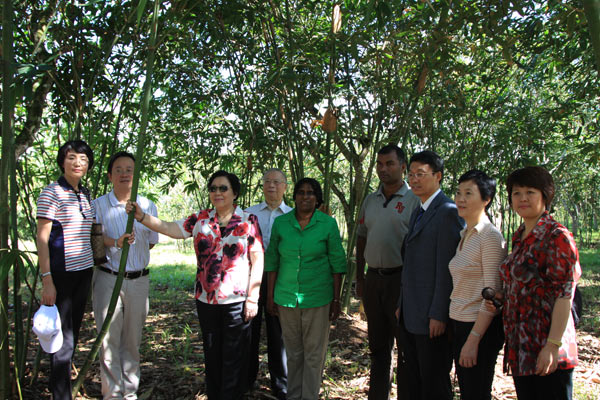
Jiang Zehui's (third right) passion for bamboo was inspired by her hometown Yangzhou and is nurtured by her life's work. Photos Provided to China Daily |
Sitting with Jiang Zehui, dressed for business neatly in black in her office, you wouldn't imagine that she is recently back from an inspection trek of bamboo forests.
She's the former vice-minister of the State Forestry Administration and president of the Chinese Academy of Forestry. Her business card simply identifies her as "chief scientist", but it almost bends under the weight of seven titles below that, including vice-chair of a CPPCC committee (Population, Resources and Environment) and fellow of the International Academy of Wood Science.
Today, bamboo is her particular passion at the International Network for Bamboo and Rattan, where she is co-chair and a founding member of the board of trustees. Her business card is printed on a woodlike bamboo wafer.
"I was inspired by my hometown in Southeast China as a child. Yangzhou city in Jiangsu province has a long tradition of bamboo gardens and use - the tradition goes back thousands of years.
"My hometown has also been described as the hometown of bamboo culture," she says. "Yangzhou has many private gardens, especially from the Qing Dynasty period (1644-1911), that we still enjoy today."
When she was preparing to go to university, she says: "I didn't really intend to be a forestry major." But based on her examinations, her proven aptitudes and the recommendations of her teachers, that was the path chosen for her.
"Until that time, I saw forests as a scenic heavens," she says, noting that the culture of bamboo is imbedded in literature. "We learn about how Chinese people adore gardens and bamboo as integral parts of gardens as small children".
She got a different picture at Anhui Agricultural University.
"I discovered that forestry was a hard subject that requires a lot of energy, study and time."
Jiang, however, was up to the challenge, as she demonstrated in a long career both as an academic and a field scientist. When her job took her to a forest, bamboo was often part of the biodiversity that awaited her.
Bamboo is a member of the family of grasses, though it's a big fella compared to our usual idea of grass. There are about 1,200 species worldwide. Some grow in clumps. Some are monopodial. They all reproduce by making runners that allow the plant to spread across a neighboring garden - or village. Some are pencil-thin, while others are thick as a post. (In fact, they make great posts.)
Bamboo's quirkily jointed surface can be green, black, purple, brown or a luminous gold, with properties similar to wood's. That makes it an attractive raw material for furniture and flooring.
The bulk of the world's bamboo grows in tropical and subtropical climates, most happily on lowland slopes. About 550 of the species are indigenous to China, which is why the plant has thrived in the Middle Kingdom's art and literature for centuries.
China is the world's biggest consumer of bamboo, but Jiang chuckles when I ask her if the country could ever run out of it.
No pandas are going to go hungry, she assures me.
"China is also the biggest exporter of bamboo," she says, noting that the country wouldn't export 54 percent of the world's trade volume if supply was a problem.
The value of China's bamboo production grew to 117.3 billion yuan ($19 billion) in 2010, a fivefold increase in less than a decade, according to the latest State Forestry Association figures. But Jiang says that only represents about 25 percent of the potential. By selecting the best varieties for different regions and better managing bamboo, she says, China can produce much more.
The great thing about bamboo, she explains, is the fact that it grows very fast. While that can be a challenge in a carefully plotted garden, it means commercial growers can harvest between one-quarter and one-third of a bamboo grove that's at least three years old - every year, pretty much forever. In fact, moso bamboo, one of the top commercial varieties, cannot be allowed to mature longer than seven years or it becomes too brittle to use in most manufacturing.
 Watermelons now come with scannable data
 Rubber Duck falls into Victoria Harbor
 Car wreck over car parts quality claim
 Gales, hailstorms batter villages in SW China
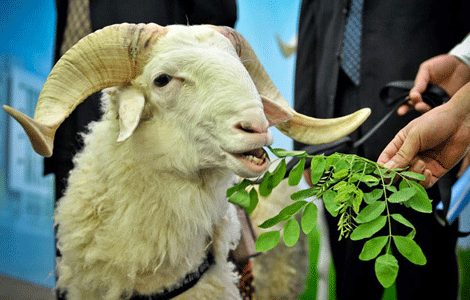 Ram with artificial heart sets survival record
 The future of wearable computers
 Anniversary quake drill jolts students
 15,000 tour memorial hall on quake anniversary
Copyright 1995 - 2010 . All rights reserved. The content (including but not limited to text, photo, multimedia information, etc) published in this site belongs to China Daily Information Co (CDIC). Without written authorization from CDIC, such content shall not be republished or used in any form. Note: Browsers with 1024*768 or higher resolution are suggested for this site.
License for publishing multimedia online 0108263 Registration Number: 20100000002731