Lamb stands the test of time
|
 |
|
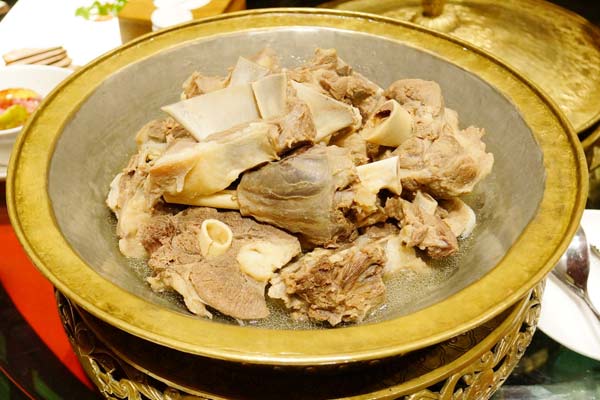
Boiled mutton is Ninety-nine Yurts' signature dish. |
With public health scares hitting sales of pork and poultry, diners are developing a renewed enthusiasm for lamb, which has a long and rich history in Chinese cuisine. Ye Jun reports.
With the impact of avian flu leading to a decline in the consumption of poultry, Chinese and Western chefs are finding a greater demand from diners for lamb dishes.
Lamb has been on the Chinese dining table for hundreds of years, and has always been safe.
"Chicken, pork or beef — they all had problems, but never lamb," says Yang Yuping, executive chef with Ninety-nine Yurts.
Yang's restaurant in Beijing offers lamb dishes in an Inner Mongolia yurt setting. He says lamb is always safe because it is raised in healthy conditions.
Back in Yang's hometown of Inner Mongolia, where his restaurant sources meat, sheep and goats are raised on grasslands, feeding on wild grass and herbs.
Ninety-nine Yurts offers popular lamb dishes, such as roast whole lamb, lamb's back, kebabs and boiled goat.
Yang says the most traditional way of cooking lamb, Inner Mongolia's signature meat, is boiling. Roast lamb, the best known dish from the region, is mostly for festivals and important occasions.
"With quality lamb you need to reduce the amount of seasoning, so as to bring out its original flavor," Yang says. "I often only cook lamb with salt and ginger."
In Beijing, a hodge-podge of styles of Chinese cuisine exists and there are many ways to cook lamb.
Xinjiang restaurants are famous for their kebabs, grilled lamb leg and fried lamb with cumin. They are more international in style, and the restaurant itself is usually jovial, with Uygur style dancing and singing performances.
A traditional way to cook lamb in Beijing is by searing thin slices of meat in a hot pot. Lamb hot pot was invented by Mongolian aristocrats but brought to Beijing by Manchu people during the Qing Dynasty (1644-1911), according to Hong Dacai, owner of Hongyunxuan, a Muslim restaurant specializing in Mongolian hot pot.
Hong still observes strict rules of the traditional lamb hot pot. He serves eight sauces, and the hot soup is clear and has no foam after the slices of lamb are boiled in it.