Learning to stand out from the crowd
As well as larger-than-ever investments, the latest reality shows all have one other thing in common - They're all authorized remakes of foreign programs.
I Am A Singer, for example, was the remake of a South Korean reality show with the same name. Super Star China is also an import from South Korea. The original is called Superstar K, and according to Zheng Xuan, director of program research center at Hubei Satellite TV, the final show attracted more than eight million viewers in South Korea. Celebrity Splash was originally a Dutch show, while Stars In Danger was a German show.
The new business model of buying formats, mainly from the Netherlands and the United Kingdom, has enabled more than 30 "new" reality shows to be broadcast in China over the past three years. And thanks to the phenomenal success of The Voice of China, an authorized remake of The Voice of Holland, the trend will undoubtedly continue.
 |
|
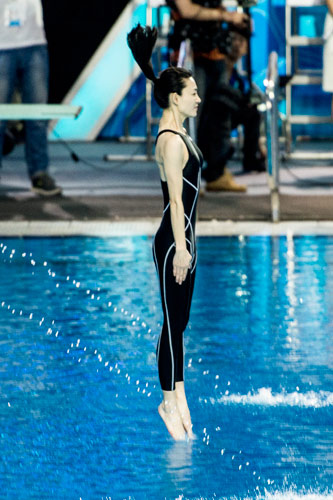
Chinese actress Wang Likun dives for the ongoing high diving show, Stars in Danger, by Jiangsu Satellite TV. [Photo/CFP] |
"After the success of The Voice of China, almost every major TV station started to search overseas for new program formats," Zheng said.
"We have also been in contact with foreign format companies. We ask them to send us the latest program ideas as soon as they have one."
Usually TV stations are given what is called "a bible", a book of detailed instructions, and sometimes a tutor to ensure a similar, if not identical, quality to the original version. That's partially the reason behind the success of The Voice of China. But despite this many shows have been flops because of their poor attempts to imitate the original.
So rather than do an exact copy, some TV shows this year have been adjusted to meet local tastes. I Am A Singer, for example, added a number of successful segments and details that are absent from the original version.
"To some extent, Hunan TV is troubled by copycatting. So while respecting the original idea, we've done considerable localization," said Li Hao, deputy director of Hunan Satellite TV.
But for TV stations like Hubei Satellite TV which barely has a full production team, they do the exact opposite and use more foreign aid to maintain the original flavor.
About 20 professionals from South Korea are involved in the production of Super Star China, and 100 more are on the way, including their scriptwriter and director.
"It's not just the introduction of the program format, but also the whole production team. Besides the ideas, things like lighting and stage setting will be exactly like the original," Zheng said.
"I know profits are being made at the expense of originality. But creating original shows takes a long time and it's easy to get them wrong. It's not money that we're concerned about. It's time."
Audiences don't seem to mind that the shows are imitations. The general agreement seems to be that it's reasonable to learn from others before you can manage on your own.
But some experts worry about the effect it will have on domestic production in the long run.
"The current competition hasn't brought to Chinese TV industry any new vitality. It's simply the repetition of similar programs. After the popularity of I Am A Singer, many channels are ready to launch their own singing shows. It's boring. There's less and less diversity," said Hu Zhengrong, professor of media studies at the Communication University of China.
Hu said differentiation is the key principle of competition. Powerful TV stations such as Hunan and Jiangsu have realized it, he said, but many are just content to follow their lead.
"The industry is superficially flourishing. It's only the random popularity of a certain product or service, not the maturity of the whole industry," Hu said.
"TV is now frequently challenged by the Internet. Netflix, for example, is producing its own dramas. If the diversity of programs doesn't increase, TV's future is truly alarming."
Xu Jifeng with Zhejiang Satellite TV agrees that fighting with imported weapons means the major TV stations in China haven't shown much progress in terms of originality. But he said there's still a long way to go.
"Besides ideas, what we still have to learn is the laws and methods of generating these ideas and content. We have to learn how to be original."

- Relief work launched after SW China earthquake
- More shipping lines cut terminal handling charges in China
- China, Australia police arrest 5 drug traffickers
- China to shift to innovation-driven economy, play bigger role in global governance: experts
- Xinjiang universities to offer Farsi, Urdu classes