Move to reduce educational gaps among regions
Nationwide evaluation and supervision of conditions in elementary and junior high schools will be launched in May to narrow the gap in educational levels among regions, the Ministry of Education said on Thursday.
China has a nine-year compulsory education system for children that covers such schools.
"But the quality of education differs among regions and schools. To promote balanced and quality compulsory education is a major task in the coming years," ministry official He Xiuchao said.
In 2011, there were 241,200 elementary schools and 54,100 junior high schools in China, with the number of students in schools receiving compulsory education standing at nearly 150 million, according to latest statistics from the ministry.
Minimum standards have been set for the evaluation and supervision of school conditions, which include educational facilities such as books, laboratory equipment, accommodations, cafeterias and teachers.
The ministry clarified different deadlines to meet such standards to reflect local conditions in the country's 31 provincial, municipal and autonomous region governments, as well as the Xinjiang Production and Construction Corps by the end of last year, He said. The corps is an economic and semi-military governmental organization in the Xinjiang Uygur autonomous region.
"For developed regions, local government authorities can set their own higher standards to evaluate schools," He said.
He, who is in charge of the evaluation and supervision, said the move will encourage local governments to increase educational investment as a major effort to promote the balanced development of compulsory education among regions and schools.
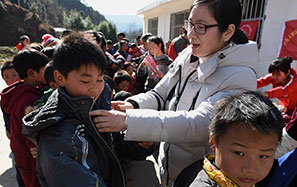
Lyu Xinwei, head of the educational department in Chengdu, Sichuan province, said the city is monitoring balanced development among schools, especially between rural and urban areas.
The number of school-age students for compulsory education in Chengdu is about 1.08 million — 400,000 from urban areas and 680,000 from rural areas, he said.
"Based on the monitoring results, the city will encourage excellent teachers to go to rural schools by offering subsidies and better training opportunities, greatly helping to realize the equal allocation of educational resources," Lyu said.
Chu Zhaohui, a senior researcher at the National Institute of Education Sciences, said the ministry's evaluation and supervision of school conditions is only a start to achieving balanced development in the education sector.
"It is common to see some well-known and high-quality schools always open to a privileged few in big cities, which is an important factor in enlarging the gap among schools," he said.
Granting equal development opportunities and policies to schools will be an efficient way to balance development among them in future, he said.