Comments
  Print
Print  Mail
Mail  Large Medium Small
 |
|
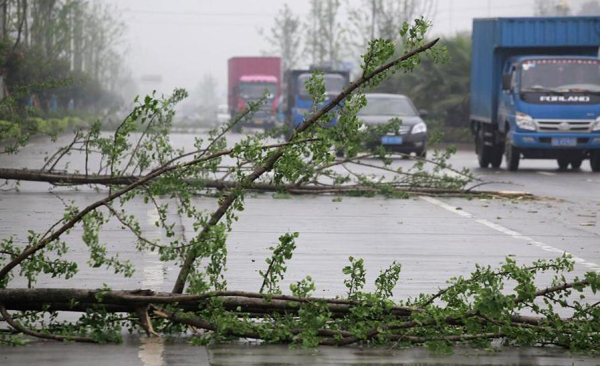
Trees are blown down by strong wind in Liuzhou, South China's Guangxi Zhuang autonomous region, March 28, 2013. Strong wind and thunder hit the city on Thursday. [Photo/Xinhua] |
Heavy rain, sleet, hail and tornados put drainage systems under pressure
The rising number of severe storms in China has revealed problems that are the result of rapid urbanization, experts say.
Many regions are coping with a growing number of storms that bring heavy rain, strong wind, lightning, thunder, sleet, hail, and in some cases, tornados.
These frequent and turbulent storms "are putting pressure on urban drainage systems and local authorities' emergency response systems," said Xie Yingxia, vice-president of the Institute of Urban Water and Engineering under the China Academy of Urban Planning and Design.
She said urban drainage networks have failed to keep pace with construction above ground, leading to more floods and traffic jams in cities hit by severe weather.
"In some cities, water can't flow into rivers or lakes because authorities have blocked the waterways, increasing the risk of floods," Xie said.
Li Weibiao, a professor of atmospheric sciences at Sun Yat-sen University, said studies show the Pearl River Delta is getting more heavy rainfall and afternoon precipitation.
Li said this shows a need for detailed impact studies to evaluate the associated risks and costs, and to develop strategies to cope with such events.
Since the beginning of March, South China has had five bouts of severe weather, claiming more than 30 lives, said Zheng Yongguang, a researcher at the National Climate Center's forecast office.
"Generally, we can forecast regional convective storms about 20 to 30 minutes before they happen," he said.
But Yuan Hongyong, deputy director of Tsinghua University's Center for Public Safety Research, said that is not enough time for China's emergency response system to inform people who may be affected.
"It takes at least 40 minutes for the system to work, from receiving a weather alert from the China Meteorological Administration to relaying that to the public," Yuan said, adding that a 20-minute forecast requires the system to be more efficient.
He said China's emergency response system can cover all cities through various ways, such as text messages, television, the Internet and broadcast media, but it still takes time to cover counties and villages.
The strongest tornado to hit Dongguan, Guangdong province, on March 20, showed how weak the alert system is. The tornado killed nine people and injured 272 others, causing a direct economic loss of more than 1.3 billion yuan ($209 million).
Fang Weidong, deputy director of the Dongguan emergency response office, conceded on March 22 that the system needs improvement.
The city's meteorological bureau issued alerts only for strong gales and thunderstorms before the disaster. It made no mention of a tornado.
According to the authority, the wind speed of the tornado was up to 176.8 km per hour .
Ma Xuekuan, chief forecaster at the National Meteorological Center, said the heavy rainfall will continue in South China into next week, and people should be aware of possible disasters triggered by continuous rain.
wangqian@chinadaily.com.cn

 Watermelons now come with scannable data
 Rubber Duck falls into Victoria Harbor
 Car wreck over car parts quality claim
 Gales, hailstorms batter villages in SW China
 Ram with artificial heart sets survival record
 The future of wearable computers
 Anniversary quake drill jolts students
 15,000 tour memorial hall on quake anniversary
Copyright 1995 - 2010 . All rights reserved. The content (including but not limited to text, photo, multimedia information, etc) published in this site belongs to China Daily Information Co (CDIC). Without written authorization from CDIC, such content shall not be republished or used in any form. Note: Browsers with 1024*768 or higher resolution are suggested for this site.
License for publishing multimedia online Registration Number: 20100000002731