Vintage afterlife
|
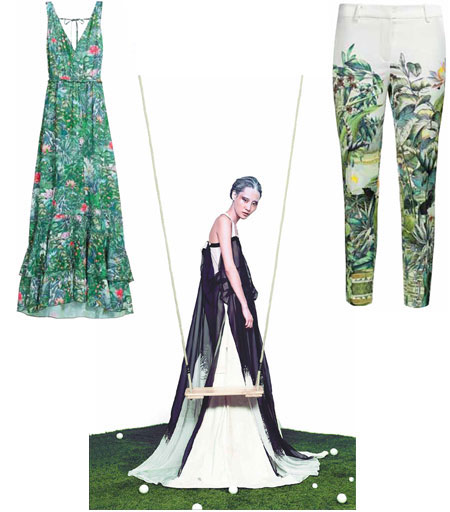
Above: Designer Zhang Na's Reclothing Bank label features garments made from second-hand clothes, while H&M's Conscious series (top left and right) are made from recycled clothing. Photos [Provided to China Daily] |
Making an old dress new again has become an art for independent designers, but the trend doesn't stop at the small shops, as Gan Tian finds out.
Old is in, new is out.
Fashionistas are always seeking the "new" garment, accessories of "this season", or "the latest collection" from the designers. However, style-conscious shoppers have recently been embracing fashion that has been recreated from discarded clothes.
Take Xie Tianchi, for example, the 31-year-old Beijing office worker who has just spent 3,000 yuan ($482) on an old A-line dress.
The dress is a patchwork: Its front is blue-striped, and the back is a whole piece of red silk. Obviously made from two kinds of materials, the dress achieves a futuristic touch with the sharp contrast of front and back.
"I simply think it is a great design. It has a cool mix-and-match style," Xie says.
The dress's creator is Shanghai-based independent designer Zhang Na. She has her own line, Fake Natoo, but she is also creating another series, Reclothing Bank, that reflects her fancy for old clothes.
As its name suggests, the Reclothing Bank label features garments made from second-hand clothes. Zhang and three other designers from her team, re-crafted these clothes, and put them in a friend's collective store. They sold surprisingly well.
The idea clicked with Zhang in 2011.
"Unlike new clothes and accessories, used items have stories. They have people's feelings," she says. When she went to a charity office in Shanghai in 2011, Zhang found many old clothes that had been donated for needy people.
After the charity workers made their selections from the items given, there were many left, which might be used to create rags or mops because they were not wearable any more. Zhang, seeing a no-longer-perfect black polka-dot dress, was suddenly inspired: "They are really good materials! Why don't I use them as the material of a new garment?"
Reclothing Bank was born. The series, just like traditional clothing lines, is produced twice a year, with spring/summer and autumn/winter collections.
The result has won applause from wearers and onlookers alike. Since it is a method of recycling fashion, people will naturally think it is eco-friendly. Chinese rising star Ni Ni picked one dress from the label, and has worn it in a series of fashion photo shoots, which were featured in the magazine Lohas.
In Beijing, Wei Minghui writes in his self-introduction for social networking websites: "My hobby is collecting garbage, and going to the old market."
The former graphic designer has achieved something by "collecting garbage". In 2009, he created a label named Neicun, which produces various kinds of stylish totes and handbags.
That idea came in 2008 when the Beijing government issued the order to curb plastic bag use. Many small shops threw away some colorful posters and advertisements made from plastic like cloth, which was also banned at that moment.
Wei carted some home, and asked a tailor to make 200 shopping bags out of these colorful discarded fabrics. He and his wife took the bags to 798 Art District and sold the bags for 18 yuan per piece - and had plenty of customers.
From that original idea of Neicun, he later developed products like iPad cases, ties, purses and briefcases.
Now his products, all made of discarded fabrics, are sold in Ullens Center for Contemporary Art Store and Brand New China store, which are famous for their artistic and innovative products.
It is not only the Chinese "indy" fashion designers who are riding this trend. International fashion labels are paying attention. Swedish fast-fashion giant H&M, for example, has launched a call-out for consumers to donate their old garments.
Catarina Midby heads the fashion and sustainability department at H&M. On a visit to Beijing, she showed an orange one-piece evening dress to reporters. The dress, priced at 699 yuan, is made of recycled polyester, which mainly comes from old garments, and wasted raw material leftover from production.
"Fashion is changing its way more to long-lasting trends, producing garments in more responsible manner, adding more values of sustainability," she says.
In H&M's current campaign, Garment Collecting, consumers can bring their old clothes to the label's boutique stores, and then get a discount of 15 percent on a purchase. It started in Shanghai on March 5, and in June the campaign will go nationwide.
These old clothes will be redesigned and sold around the world as second-hand. Those which cannot be reused will be recycled for their fibers in textile production.
At present in its Shanghai boutiques, the company receives 30 to 40 bags of donated old garments every day.
Uniqueness is one of the main attractions of these dresses. The materials are collected from different environments, so there are not many matches in patterns and styles. That means there is plenty of variety in the new garments.
In Reclothing Bank, there is only one garment for each dress design, which makes it a real "limited edition". That is why each piece of dress is priced between 2,000 to 4,000 yuan. And according to H&M, the clothes and accessories the firm creates from the old items will not be mass-produced.
Though shopper Xie has spent 3,000 yuan on the patchwork dress, she feels "every penny is worthwhile".
Many consumers wear these clothes to show their eco-friendly attitude toward life. Kate Chen, a spokeswoman for H&M, says the consumers who donate old garments and wear the recycled results flaunt a win-win behavior: They get the discount AND and show their "green" colors, too.
Contact the writer at gantian@chinadaily.com.cn.