The signs are good
Tai Lihua lost her hearing at 2 but this hasn't stopped her from achieving her dreams. Mei Jia interviews the CPPCC member and director of the China Disabled People's Performing Art Troupe.
Despite her hearing impairment, dancer Tai Lihua found it easy to communicate when she attended a session of the country's top political advisory body in mid March.
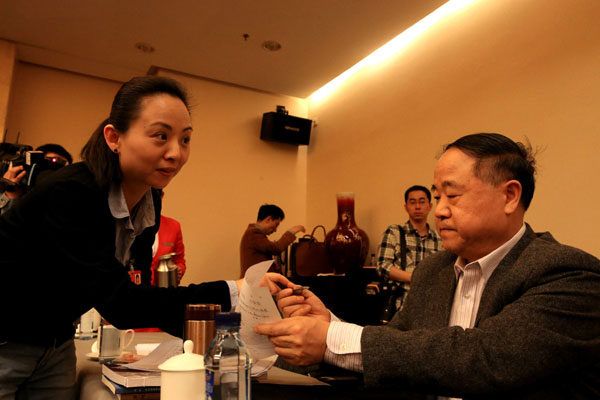
In the group discussion with actor Jackie Chan, director Feng Xiaogang, and writer Mo Yan, Tai spoke using hand gestures translated by her assistant Li Ying.
 |
|
Tai Lihua gets the signature of writer Mo Yan for her new proposal during the CPPCC meeting. [Photo by Jiang Dong / China Daily] |
"I felt comfortable, there were no obstacles (to communication) and I was also inspired by the other attendees," Tai gestures, with a smile.
The two-time member of the Chinese People's Political Consultative Conference National Committee proposed approving driving licenses for physically disadvantaged people during the two sessions of the National People's Congress and CPPCC in 2008, which came to fruition two years after.
This time her proposal centered on enriching the spiritual and cultural lives of people like her, including adding subtitles for TV news.
"In recent years, we are better off, get more respect from people, and a number of large infrastructure projects have made life more convenient," Tai says. "Now we need more food for the spirit."
According to Tai, there are 27.8 million people with impaired hearing among the 87 million people living with disabilities in the country. "Adding up the number of elderly who have to turn up the volume on their hearing aids, together with dialects, the need for subtitles on TV programs is substantial," she says.
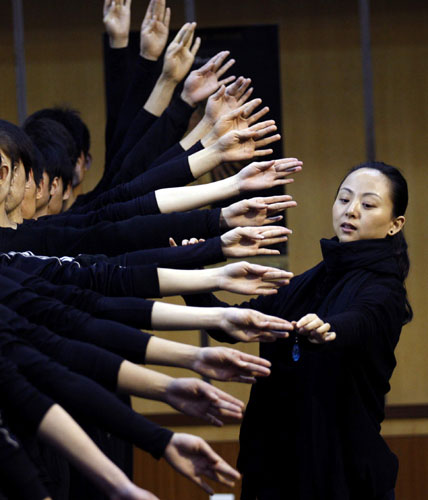
Tai brought wonder to hundreds of millions when she was the face of The Thousand-handed Goddess of Mercy dance at the CCTV Spring Festival Gala in 2005. She has gone on to perform the dance in more than 70 countries.
Born in 1976, in Wuhan, Hubei province, Tai had a high fever and lost her hearing at the age of 2.
Tai recalls her teacher writing "the handicapped" on a blackboard and was enraged. She is glad that people now refer to people like her as "living with disabilities" instead.
"I have always dreamed that people with disabilities should be treated with equal respect and have an equal opportunity to live happy lives," she says.
 |
|
Tai Lihua directs China Disabled People's Performing Art Troupe in The Thousand-Handed Goddess of Mercy dance. [Photo by Zhang Wei / China Daily] |
At 15, she made the decision to dance professionally.
"It's hard if you're dancing and you can't hear the music and the beat, because music is the soul of dance," Tai says.
Her solution was to practice harder than her peers and work on understanding the meaning of a musical work.
"My feet were often frazzled and torn, but I kept on dancing. It was my dream to dance like others and I couldn't give up."
Tai often refers to having a dream and says she was inspired by Martin Luther King's I Have a Dream speech, which led to her creating the My Dream show in 2000. The show became a signature dance of the China Disabled People's Performing Art Troupe in which Tai served as the lead dancer.
In 2002, Tai became part of the troupe's management and in 2006 she was named director.
She says cultural and moral education is as important as dancing drills for young dancers.
"She is a teacher, a trainer and a big sister for the younger dancers," says Tai's assistant Li Ying.
"The troupe travels around the world to perform and is always warmly welcomed," Tai says, "because the younger dancers are taught to behave well and politely, like making their beds and cleaning the room upon leaving every hotel."
Tai enjoys a happy private life with green plants and her beloved husband, with whom she has created their own set of gestures to communicate.
Contact the writer at meijia@chinadaily.com.cn.