Village mourns visionary former chief
 |
|
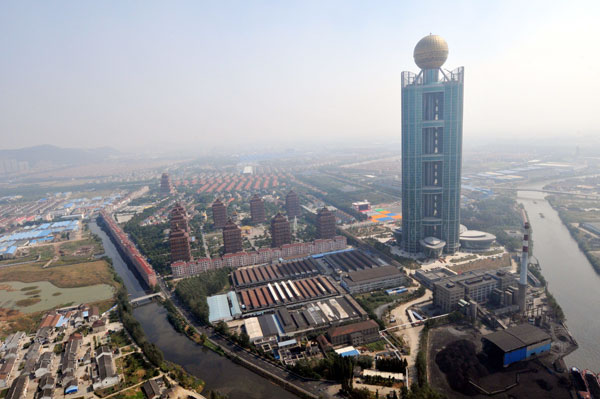
An aerial photo of Huaxi village in October 2011. Sun Can / Xinhua |
"Now the 2,000 registered residents of the village all live in villas, have luxury cars and each has an average deposit of at least 1 million yuan," said Sun.
The villagers also receive stock options and bonuses, free healthcare, and enjoy free domestic or foreign travel.
In 2010, Huaxi villagers' average annual income reached 85,000 yuan, while the figure for Shanghai citizens was 32,000 yuan.
Wu had been the chief of Huaxi since the 1950s. His fourth son Wu Xie'en took the helm in November 2002.
In the 1960s and 1970s, when other villages in China were focusing on farming, Wu talked villagers into running a metal processing plant to make money.
In 1978, when China initiated the reform and opening-up policy, Wu suggested the villagers invest their portion of the year-end bonus in village-owned factories.
In the 1980s, following the introduction of the household contract responsibility system in rural China, Wu kept the village's land as a collective asset to establish steel and textile factories, from which the village has benefited for years.
But some of Wu's high-profile behavior also sparked controversy, including showing off the village's wealth and the centralization of power among Wu's family.
The 328-meter hotel, which cost 3 billion yuan to build, has 16 presidential suites, 800 standard rooms and luxury clubs decorated in pure gold and silver. In the lobby of the hotel stands a golden bull sculpture made of 1 metric ton of gold.
 |
|
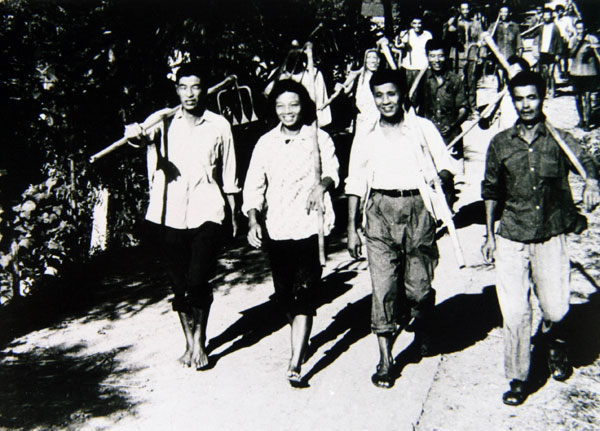
Wu Renbao (second from right), then chief of Huaxi in Jiangsu province, walks with villagers on their way to do farm work in June 1968. Chen Baojin / Xinhua |
On Nov 28 the village opened its 10,000-sq-m museum that consists of replicas of palaces from Beijing's Forbidden City. It houses tens of thousands of artworks created by famous artists.
In recent years, each villager has been given gold bullion as gifts during Spring Festival.
It was reported by China Entrepreneur Magazine's news website iceo.com.cn that Wu's four sons can dispose 90.7 percent of the village's funding, and that 36 of the around 50 leaders of Huaxi's Party committee are closely connected with Wu's family.
"The way is correct as long as it makes the villagers rich," Wu was once quoted by 21st Century Business Herald as saying in response to the controversies.
"He didn't rest for a single day after retirement," said Wu Xie'en, current chief of the village. "As his offspring, our way of showing filial piety is to respect his desire to work."
Contact the writers at cangwei@chinadaily.com.cn and songwenwei@chinadaily.com.cn