Comments
  Print
Print  Mail
Mail  Large Medium Small
BEIJING - A report released by the United Nations Development Program (UNDP) on Friday placed China 101st in a ranking of 187 countries and regions based on the quality of life enjoyed by their populations.
China measured 0.699 in the UNDP's "human development index" (HDI) in 2012, up from 0.695 in 2011. It sees China remain above the average level of regions and the BRICS nations -- Brazil, Russia, India, China and South Africa, according to the 2013 Human Development Report -- The Rise of the South: Human Progress in a Diverse World.
The report looks at the distinction between the fast-developing South, as defined in political terms, and the more developed political North.
China's 0.699 on the HDI represents a remarkable increase of 72 percent from the 0.407 it registered on this scale in 1980, or an average year-on-year growth of 1.7 percent.
The annual report, the first edition of which came in 1990, examines the profound shift in global dynamics driven by the fast-rising new powers of the developing world and its long-term implications for human development.
It adopts HDI as a major measurement of life expectancy, education levels and income to paint a picture.
UNDP Country Director Christophe Bahuet attributed China's achievement to investment in agriculture, establishing special economic zones, creating access to high-quality education, promoting social cohesion, enhancing equity and providing access to high-quality healthcare.
In addition to China, more than 40 developing countries have made greater human development gains in recent decades than would have been predicted, according to the report.
It reveals that sustained economic growth has seen the combined economic output of China, Brazil and India match the cumulative GDP of Canada, France, Germany, Italy, the United Kingdom and the United States for the first time in 150 years.
By 2030, more than 80 percent of the world's middle class will reside in the South. The Asia-Pacific region will be home to about two-thirds of the new global middle class, the report projects.
"The rise of the South is unprecedented in its speed and scale. Never in history have the living conditions and prospects of so many people changed so dramatically and so fast," the report says.
However, "economic growth alone does not automatically translate into human development progress," said Renata Dessallien, UN resident coordinator and UNDP resident representative in China, in an address to mark the launch of the report here.
"Pro-poor policies and significant investment in people's capabilities, through a focus on education, nutrition and health, and employment skills are essential to expanding access to decent work and providing sustained progress," she stressed.
The report also indicates that the South faces long-term challenges shared by industrialized countries of the North, including an aging population, environmental pressure, social inequalities, mismatches between educational preparation and job opportunities and the need for meaningful civic engagement.
Environmental inaction has the potential to halt or even reverse human development progress in the world's poorest countries, the report warns.
The number of people in extreme poverty could increase by up to three billion by 2050 unless environmental disasters are averted by coordinated global action, it says.
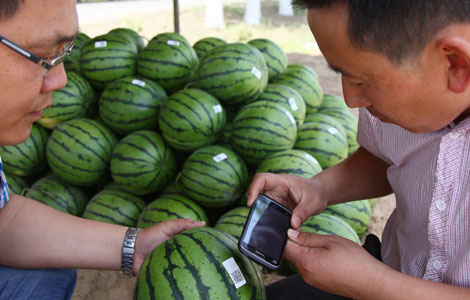
 Watermelons now come with scannable data
 Rubber Duck falls into Victoria Harbor
 Car wreck over car parts quality claim
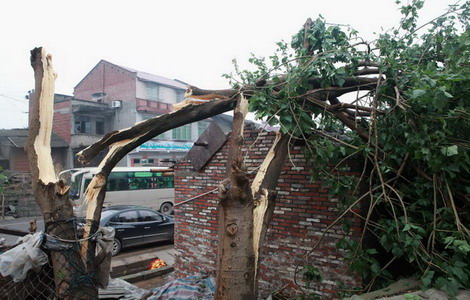 Gales, hailstorms batter villages in SW China
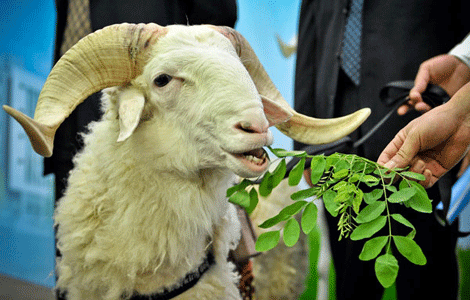 Ram with artificial heart sets survival record
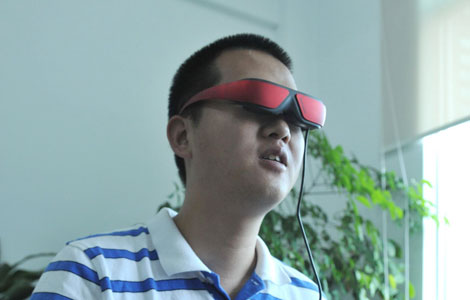 The future of wearable computers
 Anniversary quake drill jolts students
 15,000 tour memorial hall on quake anniversary
Copyright 1995 - 2010 . All rights reserved. The content (including but not limited to text, photo, multimedia information, etc) published in this site belongs to China Daily Information Co (CDIC). Without written authorization from CDIC, such content shall not be republished or used in any form. Note: Browsers with 1024*768 or higher resolution are suggested for this site.
License for publishing multimedia online 0108263 Registration Number: 20100000002731