Defense budget growth slows
Military spending to mainly cover better living and working conditions
Despite mounting pressure on its peripheral security situation, China's defense budget growth will slow in 2013 for the second consecutive year.
Experts said China is likely to continue moderately raising its defense spending in line with its economic growth, but it still lags behind major world powers in terms of per capita military spending and military equipment and technology.
According to a budget report submitted to the National People's Congress for review on Tuesday, China plans to raise its central government defense budget by 10.7 percent to 720.2 billion yuan ($114.3 billion) in 2013.
Military spending will mainly cover improving the living and working conditions of service personnel, making the armed forces more mechanized and high-tech, said the report on draft central and local budgets for 2013.
This represents a drop in the annual growth rate for two years in a row. The increase was 12.7 percent in 2011 and 11.2 percent in 2012.
Samuel Perlo-Freeman, director of the Military Expenditure and Arms Production Program at the Stockholm International Peace Research Institute, said the 10.7 percent increase announced on Tuesday "maintains what seems to be a long-standing policy of continuing to increase military spending on average at the same rate as economic growth".
According to Samuel, the IMF currently projects inflation in China in 2013 to be about 3 percent, so this will make the real increase close to the target economic growth rate of 7.5 percent. As a result, Chinese military spending in 2013 will likely remain stable as a share of GDP.
"Unless there is a major change in the regional situation in the coming years, I expect that this policy is likely to continue," Samuel said.
According to Samuel, China is increasing military spending as a natural result of its economic growth.
NPC deputy Chen Zhou said the quantity and scale of the defense budget should correspond to the requirements of national defense and match national economic development.
Chen, a major contributor to the drafting of China's defense white paper, said: "Compared to major world military powers, China's military still lags behind in terms of technology."
Yin Zhuo, director of the Expert Consultation Committee of the People's Liberation Army navy, said: "The PLA is at a stage of intensifying efforts to accomplish the dual historic tasks of military mechanization and full IT application. It is a critical moment that calls for greater defense expenditure."
Experts added that China's work on peacekeeping, naval escort missions, humanitarian aid and fighting terrorism is often several times, or even dozens of times, more costly than domestic missions.
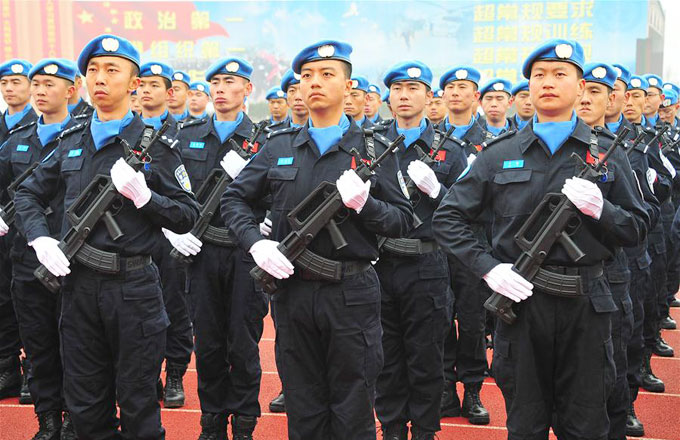
China is the largest personnel contributor to UN peacekeeping missions among the five permanent members of the UN Security Council.
Since 2008, China has sent 12 groups of naval task forces to conduct escort missions in the Gulf of Aden and off the coast of Somalia.
Chen added that China now faces a more arduous task in national security as a significant change has taken place in the international strategic situation and the balance of power in recent years, and pressure is mounting on China's peripheral security environment.
Ted Galen Carpenter, a senior fellow for defense and foreign policy studies at the Cato Institute, said China's defense spending levels "are not unusual for a re-emerging great power" and they remain far below US military spending levels.
In recent years, China's military spending amounted to about 1.6 percent of its GDP. The ratio was less than that of the US, which stood at 4.7 percent, according to a Cato Institute report in 2012.
Contact the writers at wujiao@chinadaily.com.cn
Zhang Yunbi and Xinhua contributed to this story.