A nation in transition awaits new leaders
As China prepares to elect its leaders for at least the next five years, experts are saying the new guard will have to be prepared to handle rising public scrutiny and a mixed social and economic legacy.
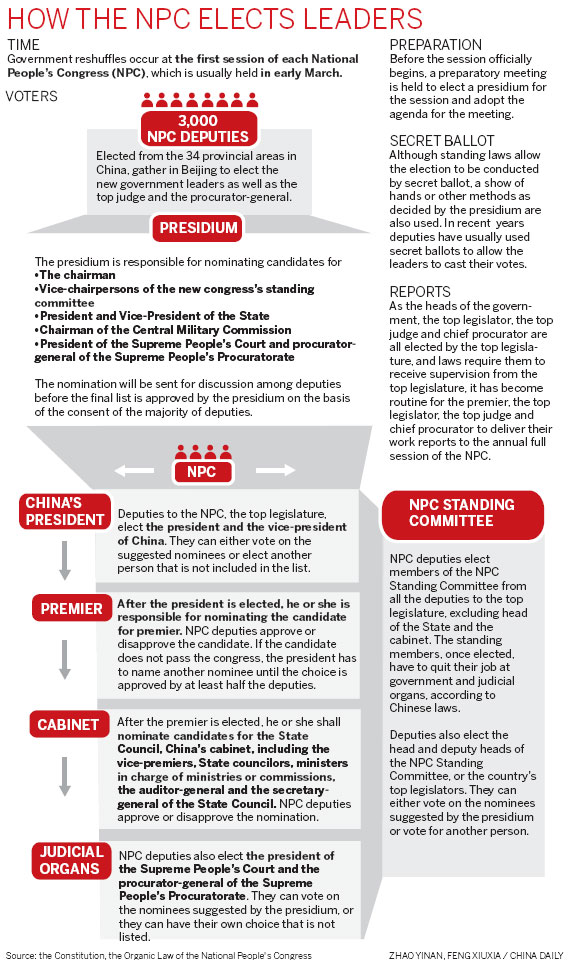
The top legislature, the National People's Congress (NPC), is due to convene its annual session on March 5. During the session, the world's second-largest economy will elect its new head of State, premier, top judge and chief procurator.
 |
| View the graphic in higher resolution |
The legislature's standing committee and ministers of the State Council, China's cabinet will also be decided at the meeting.
Such a major personnel reshuffle occurs once every five years, at which time the NPC session is usually longer than in other years because of the electoral process.
According to an NPC statement, this year's full legislative session is likely to last about two weeks, compared with 10 days last year.
Although the process this year will not differ from past elections, this reshuffle may be well remembered as the first since social media such as Sina Weibo and other micro-blogging services became widely popular in China.
Zhu Lijia, a professor of government administration at the Chinese Academy of Governance, said he expects more online voices to be heard as the meeting progresses.
Sina Weibo, the nation's largest micro-blogging service provider, said it had more than 500 million users in December, a 74 percent year-on-year increase, and at least 46.2 million users log onto Sina Weibo every day.
"The popularity of weibo (micro blogs) has enabled the public to be more involved in political events like this than ever before, and their involvement could form another force that might possibly influence the top decision-makers," he said.
"They have to address public concerns, and have to put themselves under more public supervision."
The session this year also stands out as a blueprint for the long-expected government restructuring that is expected at the meeting — lawmakers will read a plan on institutional reform submitted by the cabinet.
Jiang Ming'an, director of a law research center at Peking University, said the new leaders would be challenged by sticky issues from the start.
"It is no easy job to run a country like China. Long-standing issues such as administrative restructuring, the wealth gap and comprehensive financial, tax and institutional reform all urgently require urgent the new leaders' action, not to mention problems that emerged in recent years such as environmental pollution," he said.
Jiang said he hopes the new NPC Standing Committee — a group of about 250 members that oversees legislative affairs when deputies to the NPC are not in session — will include more members with knowledge of environmental protection and economy.
"The congress has to be composed of members of diversified backgrounds so deliberations can be thorough enough to avoid mistakes and a lack of consideration when drafting laws. At the moment, I think China needs people with backgrounds in the green industry and economics," he said.
Last year saw some social conflicts across the country that originated in disagreement over economic projects that might pose environmental risks.
In 2012, at least three violent protests against the construction of chemical projects near residential compounds broke out in Shifang, Sichuan province, Qidong, Jiangsu province, and Ningbo, Zhejiang province. The governments in the three cities eventually agreed to scrap the projects.
Mo Yuchuan, an administrative law professor at Renmin University of China, said the confrontations between residents and government officials in these cases created social tension, and that worried the leadership.
In the past month, lingering smog in North and East China has sparked huge public outcries calling for pollution control, which has also received close attention from the central leadership.
"The same happened to those rural residents who have been somehow left behind in economic growth. The new leaders may have to learn the technique of balancing development with other issues, such as the environment and people's livelihoods," Mo said.
Contact the writer at zhaoyinan@chinadaily.com.cn

- China's Alipay takes root in Lapland, near the Arctic Circle
- Snow sculpture 'Love Song' to be displayed in NE China
- Shanghai urges Apple to handle recent iPhone combustion incidents
- 'Tears of Joy' dominates 2016 emoji list: report
- Netizens support blind WWII veteran's wish to touch modern armored vehicle