Comments
  Print
Print  Mail
Mail  Large Medium Small
By observing the retail patterns of Chinese consumers, historian Karl Gerth uncovers people's standing and aspirations, as Diao Ying reports.
Karl Gerth has spent a quarter of a century learning about China, but is wise enough to realize how little he still knows. When Gerth first visited China in 1986 he was a college student with barely enough money for a pizza and a six-pack of beer. But in the eyes of his Chinese classmates, because he came from the United States he was rich.
Gerth, now a historian at the University of Oxford specializing in the study of consumerism, remembers being surprised at the absence of cars in Nanjing, where he stayed on his first trip. There was no noise, he wrote.
|
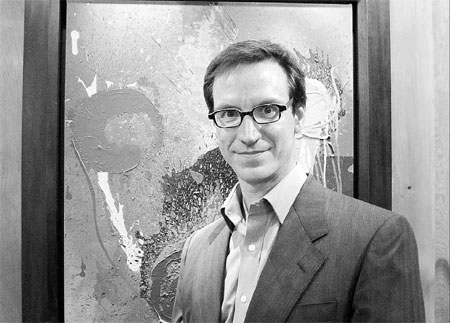 |
| Oxford historian Karl Gerth says the everyday choices Chinese consumers make will influence everything from Chinese politics to the global environment. Patricia Thornton / for China Daily |
China has changed a lot since then. It is now the world's largest manufacturer and retailer of cars and a voracious consumer of beer, among other things.
People in the West advance many reasons to explain China's economic success, the most obvious and most widely cited being Deng Xiaoping's reform and opening-up policy. However, Gerth feels that's not the whole story.
"These are facts and these are true. But we already know it," he said. Given the country's size and the pace of change, "you can say anything about China and it's kind of right".
There may be simple answers to a lot of complex questions, and they all have some truth in them, but they do not explain things thoroughly or give any clue about what we will know next, he said.
Gerth now teaches at Merton College, Oxford. His office faces the river, where he often rows for two hours in the early morning.
Books, ranging from business history to literary classics, dominate his office. One drawer has a selection of Chinese tea, acquired during trips to China, including a mix of Pu'er and ginger and Tieguanyin, or "Iron Goddess of Mercy".
As a historian, Gerth believes that history is shaped by people at the bottom as well as those at the top, and that consumption drives society as much as production. His latest book, As China Goes, So Goes the World, is an attempt to explain China from a different perspective: How the everyday choices Chinese consumers make will influence everything, from Chinese politics to the global environment.
While researching the book, Gerth was all eyes and ears; he talked to people in small shops and supermarkets and observed his surroundings. It soon became clear to him that the Chinese are driven by the "desire to have things, better things and more things".
He admitted that studying China through the eyes of its consumers is not necessarily the best approach, but it helped him discard irrelevancies and reach proper conclusions. The idea of consumerism is that people communicate who they are through the things they buy in the marketplace.
In a consumer culture, people's identities are shaped by their gender, accent and education, as well as the items they use. For example, a person who drives a gas-guzzling Hummer is not the same as someone who owns a fuel-efficient Prius.
The difference between China and the West in adopting consumer culture is its speed and scale. Since World War II, people in the West may have learned to ask for "Coke" instead of asking for "Sugar water", and Coca-Cola only opened its first plant in China in 1981. China has its own characteristics, but the Chinese are not from Mars, said Gerth. Because of China's size and the pace of change, a lot of things that happen in the country may have a different level of intensity, he said.
Those circumstances shape the way consumers see themselves, and also influence policymakers at the top, too. One of the Chinese government's main priorities is to drive domestic consumption. That's no easy task, and so the authorities need to take heed of social problems.
People talk about the Chinese being thrifty, Gerth said, but the truth is that, apart from the richest members of society, the average person needs to save enough money for housing, healthcare and their children's education before they can really open their wallet or purse and consume, regardless of the blandishments of advertising.
 Watermelons now come with scannable data
 Rubber Duck falls into Victoria Harbor
 Car wreck over car parts quality claim
 Gales, hailstorms batter villages in SW China
 Ram with artificial heart sets survival record
 The future of wearable computers
 Anniversary quake drill jolts students
 15,000 tour memorial hall on quake anniversary
Copyright 1995 - 2010 . All rights reserved. The content (including but not limited to text, photo, multimedia information, etc) published in this site belongs to China Daily Information Co (CDIC). Without written authorization from CDIC, such content shall not be republished or used in any form. Note: Browsers with 1024*768 or higher resolution are suggested for this site.
License for publishing multimedia online 0108263 Registration Number: 20100000002731