Millions on the move
3.4 billion trips
Chinese tradition holds that people should return home and spend Spring Festival, the most important Chinese holiday, with their families, which creates an annual travel rush that is the world's largest recurrent human migration.
Chinese travelers made nearly 2.9 billion trips during the 2012 travel peak. More than 235 million of those trips were by train — meaning nearly 6 million people took trains each day of the travel rush.
 |
|
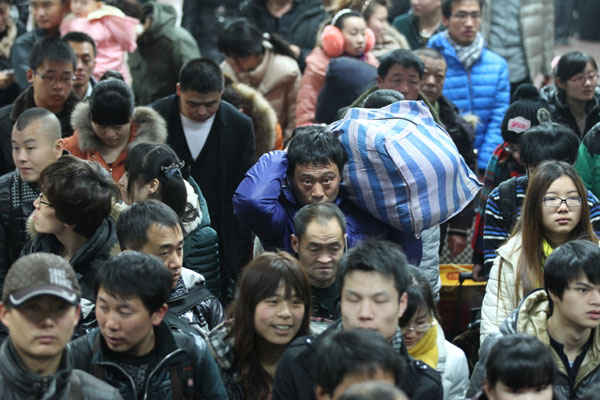
Beijing Railway Station on Feb 3 is swarming with people leaving the city to spend the Spring Festival holiday with their families. Wang Jing / China Daily |
A record 3.4 billion trips are expected during this year's 40-day holiday rush, from Jan 26 to March 6.
Of these, 3.1 billion trips will be made in private cars or buses, averaging 77.4 million per day, 9 percent more than last year, according to a Ministry of Transport forecast.
About 43 million trips will be made by ships during the period, a 1.5-percent year-on-year increase.
Transportation departments around the country will allocate 840,000 buses and 13,000 passenger ships for the travel peak.
Compared with last year's travel peak, this year will see more short or medium-distance journeys on the roads and a larger movement of migrant workers. The number of trips made by rural residents will surge, according to He Jianzhong, a Ministry of Transport spokesman.
The Ministry of Railways expects 220 million train trips to be made during the peak period this year, averaging 5.6 million a day.
To handle the flood of rail passengers during the Spring Festival travel peak, authorities will temporarily schedule 900 extra train trips a day, increasing the total number of daily trips to 5,134, said Wei Ruiming, a Ministry of Railways official in charge of operations.
Wei said 621 comparatively low-speed trains without air-conditioning would run each day during the travel peak for passengers such as migrant workers who cannot afford bullet train tickets.
Extra trains from Beijing, Shanghai and Guangdong province, where large numbers of these migrant workers are employed, were prepared to take them back to Sichuan province, Chongqing and other regions.
The traditional strain on lines linking cities that attract these workers in the northeast and south has been alleviated with the launch of new high-speed lines.
- Toll-free highways ensure smooth holiday travel
- Expats skip travel for fun in the capital
- Guiding travelers a labor of love
- Cold snap disrupts festival travel rush
- China tightens traffic checks during travel rush
- Spring Festival travel fashion
- Beijing airport prepares for travel peak
- Young travelers during Spring Festival rush
- 70,000 railway police deployed for travel rush
- Spring Festival travel rush starts around China


- You can lead a donkey to water in NW China, for now
- Musical invention improves sound quality without the traditional price tag
- Supermarket in talks with father of boy killed by falling locker
- China's water quality improves in first 9 months
- Taiwan manufacturing posts narrower decline in output value