Xi's appeal to curb waste gets warm response
 |
|
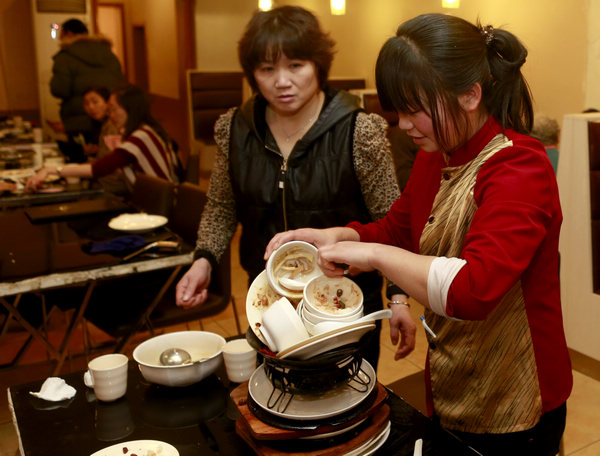
Servers clean plates at a restaurant in Beijing on Tuesday. The recent appeal to fight against extravagance has helped reduce the amount of waste at restaurants. [Feng Yongbin / China Daily] |
Leader calls for resource-saving measures
The recent appeal made by the Party's top leader Xi Jinping to fight against extravagance and waste of resources has received an enthusiastic response from Chinese officials and members of the public.
In his comments in a news story by the Xinhua News Agency, Xi said it is shocking to know the huge amount of food that is wasted in China.
Considering that there is still a significant number of Chinese people living in poverty, rigorous measures are called for to stop the serious waste of resources, Xi said.
He urged publicity authorities to strengthen their efforts to improve the public's awareness of waste, noting that the time-honored Chinese tradition of "being diligent and thrifty" and the idea of "honor to frugality and shame to extravagance" should be promoted among all walks of life.
Party organs, government departments, military units, public-funded institutions, State-owned enterprises and officials at all levels should strictly obey resource-saving measures and firmly eliminate the waste of taxpayers' money, the top leader said, requesting supervision and inspections to be intensified over officials' extravagant acts.
Xi's call has been echoed by Party members and officials who said the general secretary's requests should be fulfilled immediately, Xinhua reported on Tuesday.
They suggest authorities should start by removing lavish events and reducing waste during the ongoing sessions of local legislators and political advisers and the Spring Festival holiday, according to the report.
Normally, the annual meetings of local legislators and political advisers, which are often referred to as the two sessions, take place in January and before Spring Festival. In the past, meeting organizers usually accommodated attendees in luxury hotels and held sumptuous banquets in their honor.
The situation has gradually changed.
Organizers of the two sessions in Beijing abandoned a long-followed practice of decorating meeting venues with banners and flowers and provided simpler dishes to representatives.
Wang Hongzhong, a deputy to the capital's people's congress and a district chief, said the refreshing atmosphere relieves officials from some unnecessary routines.
"Previously, we, the grassroots officials, would be very busy coping with various kinds of visits or meetings before Spring Festival, but this year we are freed from these troubles," he said. "Without those unnecessary formalities, officials can save more time and use it for their work."
"My bureau has made a rule stipulating that no alcohol should be served at bureau's dinners, and bureau officials must not attend banquets in restaurants when conducting inspections," said Qi Jing'an, director of Beijing Entry-Exit Inspection and Quarantine Bureau.
"We've paid more attention to handling the district's officials who are found wasting food or other resources at their work," said Li Yueqi, a deputy to Shanghai Municipal People's Congress and the chief of the city's Jinshan district.
Li added that the district government has asked all legislators and political advisers from the district to take public transportation, instead of using official vehicles, to their meeting venues when attending the two sessions.
Discipline watchdogs in Shanghai will send supervisors or plainclothes inspectors to check whether government departments have put an end to extravagant behaviors, according to Xinhua.
Members of the public said Xi's words represent their consensus and wishes.
"Some officials spent more than 10,000 yuan ($1,600) on a meal to have a feeling of being wealthy, while others wasted almost half of their banquet out of ostentation. These phenomena are most loathed by the public," said Li Ji, a 30-year-old Beijing resident.
"It is easy to talk about changes but hard to adopt them. My concern is whether those officials who enjoy extravagant banquets or lavish ceremonies can change their habits instead of coming up with tricks to circumvent public scrutiny," said a netizen in Hunan province with the username Pingzier115.
Yu Ran in Shanghai contributed to this story.
zhaolei@chinadaily.com.cn




- Illegal production, storage of explosives blamed for fatal NW China blast
- 71.3 percent college students treated unfairly during internships: survey
- Free Wi-Fi on 90% of Beijing buses by end of year
- Post-90s Vietnamese woman becomes a Shanghai model
- China's 'Little Bee' searches for strongest blasts in universe