Experts fear smaller cities can't afford lines
Following a surge in subway investment last year, construction of urban rail systems in China will continue to grow rapidly this year, which has caused some experts to worry about the financial risks it can pose to local governments.
The total investment in urban rail plans approved last year reached nearly 1 trillion yuan ($160 billion), including 360 billion yuan for projects that have passed feasibility studies, which means these projects can start construction, according to the National Development and Reform Commission.
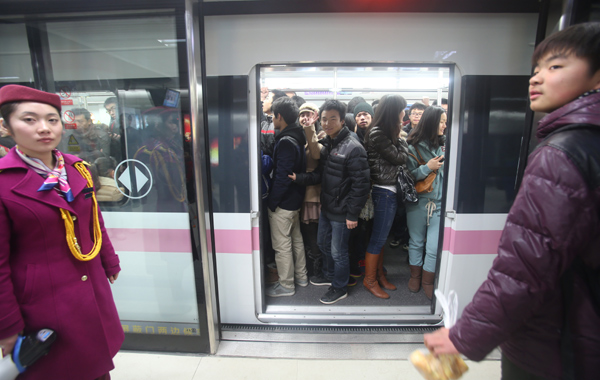 |
| Passengers squeeze on board subway Line 2 in Wuhan, Hubei province, in December. [Photo/China Daily] |
In September, the commission approved 25 subway projects in 18 cities with a total investment of more than 800 billion yuan.
Two months later, the commission approved the urban rail plans of four other cities — Beijing, Nanchang, Fuzhou and Urumqi — with a total investment of 135 billion yuan.
Thirty-five cities in China were building subways in 2012, with an estimated investment of 260 billion yuan, according to a report of the Comprehensive Transport Research Institute of the commission.
Four subway lines in Beijing opened in December, bringing the length of its subway lines to 442 kilometers.
In Wuhan, capital of Hubei province, the city's first subway opened on Dec 28. The 27-km subway, at a cost of more than 15 billion yuan, is the first one in Central China.
The city's subway operator, Wuhan Metro, said on Tuesday that nine more subway lines will be built this year with an investment of at least 16 billion yuan.
Besides Wuhan, many other second- and third-tier cities, including Changsha and Kunming, are also building or expanding their subway lines.
Another 24 cities will open new subway lines this year, according to the report by the Comprehensive Transport Research Institute.
"With surging costs in building and operating subways, many smaller cities waiting to get approval for subway construction will simply not be able to afford to operate them even if they are completed," said Wang Mengshu, a member of the Chinese Academy of Engineering and a prominent expert in underground engineering.
Although subways can help reduce traffic volume on city roads and ease congestion, rapidly increasing construction costs have made them harder to afford, Wang said.
"One kilometer of subway can cost as much as 700 million yuan to 1 billion yuan now," Wang said. "Besides, operating costs are increasing. This has put a heavy financial burden on many local governments, who borrowed the money to build subways."
Tang Liming, a researcher with Anbound, a Beijing-based consultancy firm, said: "Most subways in China are operating with deficits.
"Even subway Line 4 of Beijing, operated by Hong Kong Mass Transit Railway, needs a heavy subsidy from the municipal government," Tang said.
Most of the investment for subways came from the government and bank loans, according to Chen Xunru, a member of the National Committee of the Chinese People's Political Consultative Conference, who conducted research into subway construction.
"Subways can barely attract investors, as the tickets are usually set very low by the government to benefit the public," he said in March.
A passenger has to pay just 2 yuan for a trip on Beijing's subway, regardless of the distance.
More than 4 billion yuan is spent to subsidize Beijing's subway operations annually, Wang Mengshu said.
"Construction and operation of the subway system is very expensive, which is not affordable for many cities. That is why the central government sets strict standards to approve the construction of subways," Wang said.
A city is eligible to build subways only if it has an urban population of more than 3 million, an annual GDP that exceeds 100 billion yuan, and a local government budget higher than 10 billion yuan. In addition, the one-way traffic flow must reach 38,000 people at peak time, according to the National Development and Reform Commission.
"However, some less developed cities in inland China manipulated the figures to meet the requirement," Wang said.
Tang, the researcher from Anbound, said an incentive for some second- and third-tier cities to build subways is to increase their GDP with huge investments.
"A city government may be able to afford the construction of the subway, but operation of the subway will also be costly," Tang said. "But they don't have to worry about it as the financial burden will be shifted to the next term. That's why so many cities are building or planning to build subways."
Wang suggested the standard for subway construction approval should be upgraded to eliminate risks.
"Even if a city meets the basic requirements, it should not be given the green light if it has problems in fundraising, or it has other means to ease traffic."
Contact the writers at wangxiaodong@chinadaily.com.cn and zhoulihua@chinadaily.com.cn



Copyright 1995 - . All rights reserved. The content (including but not limited to text, photo, multimedia information, etc) published in this site belongs to China Daily Information Co (CDIC). Without written authorization from CDIC, such content shall not be republished or used in any form. Note: Browsers with 1024*768 or higher resolution are suggested for this site.
License for publishing multimedia online 0108263 Registration Number: 130349