BEIJING - In ravaging cold, when Chinese people living in northern cities are enjoying indoor warmth, southerners wonder how long they have to wait for before the government decides to install a public heating network.
The problem is they are trapped by a line drawn by late Premier Zhou Enlai six decades ago.
 |
|
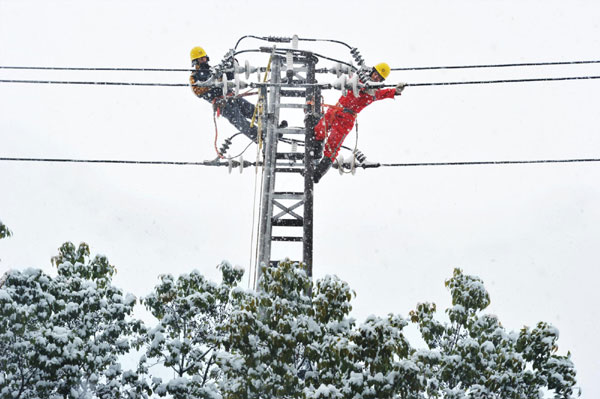
Workers repair electricity lines in snow in Shaoxing city, Zhejiang province on Jan 4, 2013. Snow and icy rain pelted Chinese provinces of Hunan, Jiangxi, Anhui, Zhejiang and Guangxi Zhuang autonomous region on Jan4, 2013. [Photo/Xinhua] |
The line, which stands between 32 and 34 degrees north latitude, almost along the Huaihe River and Qinling Mountains, not only defines China's northern and southern parts, but also determines different winters for the people.
Cities to the north of the line have public heating which circulates hot water generated by government heating stations through pipelines and radiators inside almost every resident's building and public facility.
Room temperatures in the north could be more than 20 degrees Celsius.
However, people living in cities to the south of the line, including the country's largest city Shanghai and other major metropolitans Chongqing, Nanjing, Wuhan, have to use various private and isolated heating devices to warm their freezing and humid houses.
The southerners have been plagued by the winter chill and have been complaining, especially after cold-air outbreaks when snow and ice have frozen southern provinces such as Hunan and Guangdong.
"Without heating indoors, even getting up takes a lot of courage," "wangzikai" said on the popular twitter-like Sina Weibo.
Dai Tongtong, a freshman studying in Central China's Wuhan city, is a northerner. She said the cold mixed with moisture in the south affects her no matter how thick her clothes are.
To get away from cold of the dormitories, she and her fellow students cram into libraries and public reading rooms to share warmth generated by air conditioners.
In an opinion poll conducted by www.qq.com on Thursday, 88 percent of a total of 104,618 participants voted to install a collective public heating network in the south.
Some local governments in the south have started to build trial heating networks in urban communities, while national legislators and political advisors still endeavor to persuade the central government in giving local governments the option to construct public heating networks covering whole cities.
Zhang Xiaomei, a member of the Chinese People's Political Consultative Conference, China's top political advisory body, said pushing the line southward can not only warm the public, but also expand domestic demand and increase employment.
Zhang added it is also "a solution for energy conservation and emission reduction," on which industry insiders and experts have yet to reach a consensus.
Related stories:
China sees coldest weather in 28 years
South, East China battle against snow



Copyright 1995 - . All rights reserved. The content (including but not limited to text, photo, multimedia information, etc) published in this site belongs to China Daily Information Co (CDIC). Without written authorization from CDIC, such content shall not be republished or used in any form. Note: Browsers with 1024*768 or higher resolution are suggested for this site.
License for publishing multimedia online 0108263 Registration Number: 130349