Comments()
  Print
Print  Mail
Mail  Large Medium Small
Projects ensure safe drinking water, reports Wu Wencong in Sichuan.
Li Linxu pointed to the mountain opposite his farmhouse where clean spring water flows into his village. "That's the source of our drinking water now," Li said.
"The water we used to drink tasted muddy, no matter whether it was being used to cook rice or make tea. If I had continued to use it no tourists would have come to eat at my farmhouse."
The 40-year-old, who runs a small business providing tourists with food and accommodation, lives in a small village called Tasha in Yibin, a city at the west end of the Yangtze River in Sichuan province. Li and his fellow villagers have only had access to tap water since 2005.
 |
|
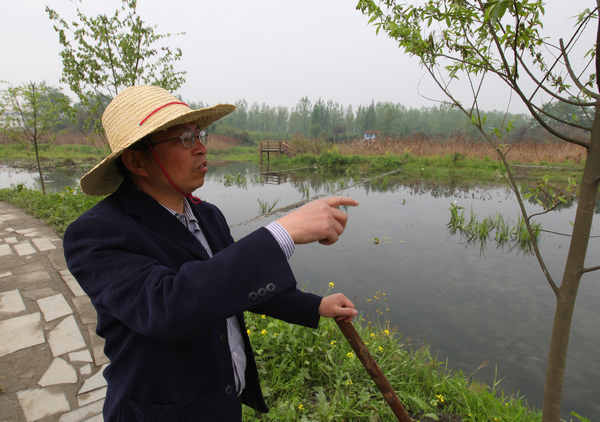
Zhang Ankui, a farmer from Yunqiao village in Pixian county, Sichuan province, points out the wetland near his village. The area is one of the major water sources for Chengdu, the capital of Sichuan province. Liu Gang / for China Daily |
They are among almost 20 million people in Sichuan's rural areas whose concerns about the safety of their drinking water have been alleviated during the past five years. The village's small pond that used to provide all their water has long dried up.
"Ducks swam in it and we used to drink the untreated water," said Li. "Some people had diarrhea occasionally after drinking the water."
According to a 2004 survey conducted by the provincial government, more than 31 million people in rural areas had no access to safe drinking water.
In a bid to solve the problem, more than 9 billion yuan ($1.43 billion) was invested in the province over the next five years to solve the problem.
With the construction of 300,000 water supply projects in rural areas, about two-thirds of those previously affected are now guaranteed clean drinking water. That increased the total percentage of those with access to safe drinking water in rural areas to 77.4 percent in 2011 from 53.3 percent in 2004.
Zhang Lei, deputy head of Sichuan Provincial Bureau of Rural Water Resources, said that quality is the core of the four criteria required for safe drinking water. The other requirements are: the daily quantity of water per capita has to reach a certain level; the water should be provided continuously; and safe drinking water should be accessible within a round trip of roughly 20 minutes.
The results of environmental monitoring show that the percentage of centralized drinking water sources in Sichuan province that attained the required standard of quality rose to 81.2 percent in 2010 from 68.5 percent in 2006.
One of the most effective methods that enabled that increase is a project called "Head of the River", whereby leaders at different levels of government are appointed as "heads" of local rivers and are therefore responsible for the treatment of pollution. Those who fail to meet the standards set at the beginning of each year risk losing their positions.
The method was first implemented in 2007, in Wuxi, in Jiangsu province. Following its adoption, the percentage of monitoring points that reached the required standards surged from 53 percent to more than 70 in the first six months.
Sichuan also recorded impressive figures when the scheme was introduced in the province. Yang Rong, head of the pollution prevention and control department at the Sichuan Provincial Bureau of Environmental Protection, said that by 2009 all the monitoring points on the Tuojiang and Minjiang rivers recorded levels of cleanliness that reached the national standard. Only five years before, in 2004, the percentage along the Tuojiang River was zero.
One regime that is unique to the province involves the imposition of a fine managed by the provincial department of finance. If an upstream city pollutes river water and then allows it to flow through cities downstream, it faces a heavy fine. The provincial government also reallocates funds allotted to the upstream city and gives a share to those affected downstream
The basic fine ranges from 200,000 to 500,000 yuan, and can be doubled and redoubled if pollutants, such as ammonia nitrogen, are discovered or if levels of chemical oxygen demand - an important indicator of how heavily the water is polluted - exceed the safety levels, according to Yang.
Six cities and counties paid a total of almost 12 million yuan in fines from September to December 2011, Sichuan Daily reported in February.
Copyright 1995 - 2010 . All rights reserved. The content (including but not limited to text, photo, multimedia information, etc) published in this site belongs to China Daily Information Co (CDIC). Without written authorization from CDIC, such content shall not be republished or used in any form. Note: Browsers with 1024*768 or higher resolution are suggested for this site.
License for publishing multimedia online 0108263 Registration Number: 20100000002731