

 Comments
  Print
Print  Mail
Mail  Large Medium Small
VLADIVOSTOK, Russia - Chinese President Hu Jintao on Saturday stressed the need for the Asia-Pacific region to upgrade infrastructure and discussed China's current economic situation and economic policies.
During a keynote speech at the Asia-Pacific Economic Cooperation (APEC) CEO summit, Hu said the world economy was recovering slowly and there were still some destabilizing factors and uncertainties.
 |
|
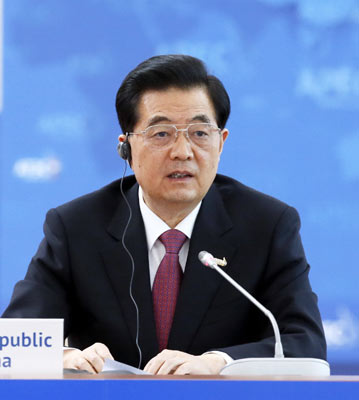
President Hu Jintao speaks at the 20th APEC Economic Leaders' Meeting in Vladivostok, east Russia, Sept 8, 2012. [Photo/Xinhua] |
In this regard, the Chinese president put forward a four-point proposal on infrastructure development in the context of promoting stable growth and recovery in the Asia-Pacific region.
Firstly, Hu said, the region should speed up infrastructure development to strengthen the foundation of development.
Secondly, the Asia-Pacific region should improve the connectivity and efficiency of its supply chains to ensure the smooth functioning of infrastructure, Hu said.
Hu said thirdly that the region should deepen reform of the investment structure to share opportunities in infrastructure development.
Fourthly, Hu said, the Asia-Pacific region should strengthen exchanges and cooperation to jointly promote regional connectivity.
"In addition, APEC members need to strengthen regulatory coherence and people-to-people exchanges and conduct wide-ranging and multi-level cooperation in promoting connectivity," the Chinese president said.
 |
| Special coverage: Hu attends APEC Summit |
These efforts have ensured the stable performance of China's economy, with its GDP, in the first half of the year, growing by 7.8 percent year on year and retail sales increasing by 14.4 percent, Hu said.
There are challenges, Hu said, such as a lack of balance, coordination and sustainability that still weigh on the country's economic growth and notable downward pressure remains, especially for small and medium enterprises and exporters.
To meet these challenges, China will continue a proactive fiscal policy and a prudent monetary policy, ensure continuity and stability of macroeconomic policies, and make macroeconomic regulation more targeted, flexible and forward-looking, Hu said.
China will take four steps to boost domestic demand and maintain steady and robust growth, while keeping the price level basically stable, Hu said. The president enumerated the moves as ways to promote home-driven growth, boost inclusive growth, advance innovative-driven development and work to achieve mutually-beneficial and win-win outcomes.
China will foster an open and transparent legal environment, an environment for fair market competition, and a stable and orderly business environment to create good conditions for investors, he said.
Beijing will move faster to implement the Free Trade Agreement, strengthen ties with key trading partners, and deepen pragmatic cooperation with other emerging markets and developing countries, he said.
During a speech at the 20th informal economic leaders' meeting of the APEC forum Saturday, the Chinese president announced that China will host the Asia-Pacific Economic Cooperation (APEC) economic leaders' meeting and related gatherings in 2014.
"China wishes to take this as an opportunity to deepen cooperation with other APEC members and make fresh and even greater contributions to the development, prosperity and people's well-being in the Asia-Pacific region and beyond," he said.
Also on Saturday, Hu and his Indonesian counterpart Susilo Bambang Yudhoyono discussed bilateral cooperation and other issues of common concern on the sidelines of the annual APEC Economic Leaders' Meeting.
The well-developed China-Indonesia relations have brought concrete benefits to the two peoples, Hu said, adding that strengthening bilateral strategic cooperation is in the interests of both countries and will serve as a model for the region.
The Chinese president put forward a three-point proposal in a bid to advance bilateral ties in the spirit of mutual benefit and common development.
The Indonesian leader expressed confidence that the two countries will achieve the goal of boosting two-way trade to 80 billion US dollars by 2015.
Indonesia welcomes Chinese companies to participate in major infrastructure projects, manufacturing and energy industry, said Yudhoyono.
The Chinese president was here to attend the two-day APEC Economic Leaders' Meeting.
APEC, a premier economic forum in the Asia-Pacific region, was established in 1989. It has grown to encompass 21 members spanning four continents, and accounts for about 40 percent of the world's population, 57 percent of the global GDP and 48 percent of the world trade.
The APEC CEO summit, an annual forum for representatives of the Asia-Pacific business leaders, is part of a series of meetings organized for leaders and senior officials from all APEC economies.

 China Daily weekly pictures: Feb 13-19
 Two black swans 'get married' in Hunan
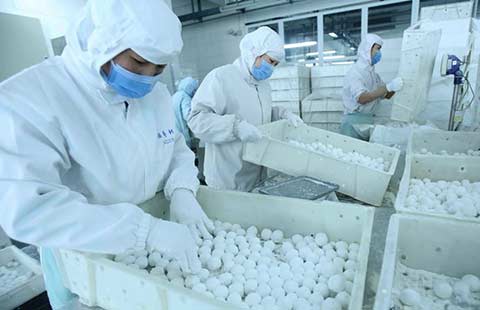 Cooks make Yuanxiao for upcoming Lantern Festival in Beijing
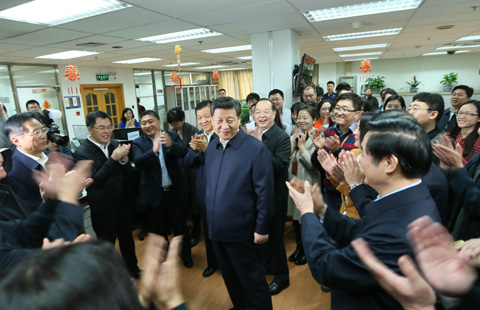 President Xi visits major State media in Beijing
 Missing children found safe in nearby village; 5,000 had been searching
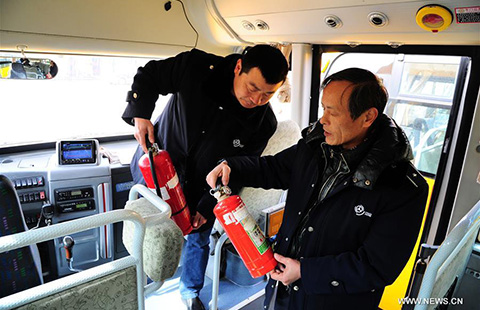 China starts safety check for school buses as new semester draws near
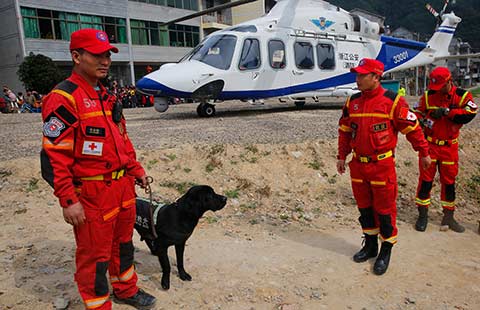 Search for three missing children continues
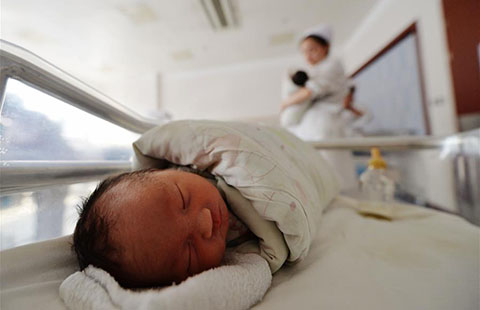 Gansu sees baby boom at beginning of Lunar New Year
 Photos show how Spring Festival is celebrated in Northeast China
China Daily weekly pictures: Feb 13-19
Photos show how Spring Festival is celebrated in Northeast China
China Daily weekly pictures: Feb 13-19
 Australia risks missing climate change commitments: report
 Meet Melanie, the real-life mermaid
 Denny Hamlin beats Martin Truex Jr. in closest Daytona 500 finish ever
 Errani wins by a mile in Dubai against Strycova

Copyright 1995 - . All rights reserved. The content (including but not limited to text, photo, multimedia information, etc) published in this site belongs to China Daily Information Co (CDIC). Without written authorization from CDIC, such content shall not be republished or used in any form. Note: Browsers with 1024*768 or higher resolution are suggested for this site.
License for publishing multimedia online 0108263 Registration Number: 20100000002731