Counties to balance access to education
By Cheng Yingqi and Xu Wei (China Daily)
Updated: 2012-11-14 01:01
 Comments()
  Print
Print  Mail
Mail  Large Medium Small
Education authorities plan to balance access to education in counties to enhance fairness, Education Minister Yuan Guiren said on Tuesday.
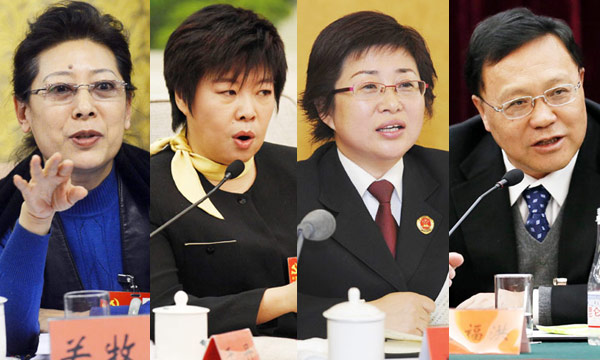
Yuan made the remark in an online news conference during the 18th Party Congress, which invited Internet users and media reporters to discuss the most popular education topics with the minister and other Party Congress delegates.
When asked about the latest measures to enhance education equality, Yuan said that in recent years the Chinese government has launched a series of projects to sponsor students from poverty-stricken regions, and to narrow the urban-rural gap and regional gap in the distribution of education resources.
"Now we are promoting compulsory education equality in counties — we are improving facilities in less privileged schools, encouraging principals of famous schools to rotate to less famous schools in the same county, and promoting resource sharing among schools in the same county," Yuan said.
In September the State Council released a plan that would see 65 percent of counties balancing their education resources by 2015, with 95 percent of counties achieving that goal by 2020.
"(Balancing) the allocation of education resources within a county or district is much more practical than between east and west or urban and rural areas as the county or district authority would be directly responsible for it," said Yuan Guilin, a professor of rural education at Beijing Normal University.
"It is difficult to push for a balanced allocation of education resources between east and west, and urban and rural areas, because it is difficult to coordinate between different local areas," he said.
However, Yuan Guilin cautioned that evaluation systems and standards must vary according to counties' economic development.
"The evaluation indexes must vary depending on the degree of economic development of different counties or districts. Also, there cannot be a universal timetable for all the counties," he said.
In January, the ministry published an index system to evaluate a county. According to a report from China News Service, the index is based on research involving 300,000 schools in 3,000 counties across China, and includes 17 basic criteria such as student-faculty ratio, number of computers per student, and number of teachers with intermediate certificates or above per student.
However, attracting teachers to rural areas might be "the most difficult challenge" school principals encounter, said Zhou Biaoliang, principal of a rural primary school from the Guangxi Zhuang autonomous region.
"I think the government can improve conditions for rural teachers in three ways — improve their accommodation and working environment, provide more training and create an award system for excellent rural teachers," she said. "We need to make sure that rural school teachers feel a sense of pride and self-worth."
China has more than 12 million teachers in its schools. Eighty percent are in rural areas.
Yuan Guiren, the education minister, said the ministry has been adopting measures to encourage teachers to stay in rural schools.
"We have provided free education for 63,000 students of normal education, 92 percent of them went to schools in rural areas in Central and West China.
"Also, we increased the salaries of rural teachers, and improved accommodation conditions for them," Yuan said.
Contact the writers at chengyingqi@chinadaily.com.cn and xuwei@chinadaily.com.cn
Related Stories
Govt to forge ahead on free preschool education: Ng 2012-11-13 07:03
A road to education system reform 2012-11-05 08:13
Bank helps education in Guizhou 2012-11-12 10:42
Education boosts role of local women 2012-11-07 10:21
Top News
A new generation of leaders
Xi's address to the media
World welcomes China's leadership change
Video