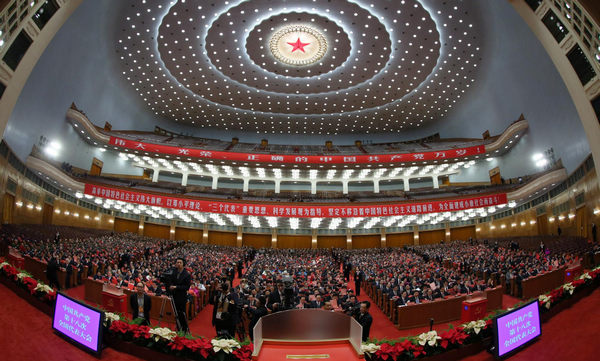
Delegates hail motion proposal
By Wang Huazhong (China Daily)
Updated: 2012-11-13 07:46
 Comments()
  Print
Print  Mail
Mail  Large Medium Small
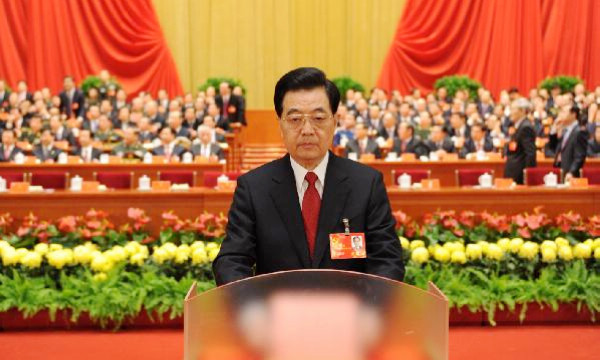
Delegates to the 18th National Congress of the Communist Party of China have hailed a proposal in President Hu Jintao's report to introduce a motion system that enables Party delegates to collectively put forward their opinions and suggestions - like legislators do - to develop democracy within the Party.
In his report to the congress, Hu said intra-Party-democracy, which is the "life of the Party", should be further promoted to enhance the Party's vitality.
The implementation of the motion system was listed as one of the measures in the report.
Experts said the motion system, along with a tenure system that maintains the status of elected delegates for a certain period after the congress ends, will fulfill Party members' right to know, engage, elect and supervise.
"The motion system means delegates will not only carry out their duty to vote, but also become empowered to fulfill their rights," said Liang Yanhui, a professor specializing in Party building at the Party School of the CPC Central Committee.
"This is one of the most important and direct ways for delegates to participate in the Party's decision-making process," Liang said.
In 2008, the CPC Central Committee issued a regulation about the Party delegates' tenure system, saying that delegates can collectively submit motions within the jurisdiction of each congress.
The act requires that any motion should include the cause, grounds and proposed solutions to the issue raised.
So far, seven provinces including Zhejiang and Hunan have established their own motion-based systems.
In addition, liaison offices for delegates have been set up in 780 counties and districts, and 174 cities and prefectures of 27 provincial-level regions, according to a report from Xinhua News Agency.
In Zhejiang, local Party congresses began to pilot the motion system in June, allowing any group of more than 10 delegates to collectively submit their motions.
Any motion raised by a delegation should get the approval of at least half of the delegation members before it is submitted.
The related Party authorities dealing with the motion have to reply to the delegates in written form.
They need to repeat the process within one month if the delegates are not satisfied with the answer or face disciplinary action.
Some delegates to the congress told China Daily on Monday they are pleased that the Party has introduced such a systematic way to raise suggestions regarding the Party's policies and decisions.
"Delegates discuss at every level of congress. But these vocal discussions do not make any difference without a motion-based system," said Wu Tianlai, a delegate from the Guangxi Zhuang autonomous region.
Yan Guizhen, a middle school teacher and a delegate from Gansu province, said the motion system is a step forward, showing that the Party is attaching even more importance to listening to its members' views.
"Moreover, my surveys over the years on problems in education would be more meaningful. I'm excited that we can more effectively reflect public opinion in the Party's decision-making process," Yan said.
wanghuazhong@chinadaily.com.cn
Related Stories
Entrepreneurs' presence grows at CPC congress 2012-11-12 21:40
Hot issues deliberated at CPC congress 2012-11-12 16:22
Election methods of CPC National Congress approved 2012-11-10 19:44
Intl community lauds Hu's report at CPC congress 2012-11-10 14:18
Top News
A new generation of leaders
Xi's address to the media
World welcomes China's leadership change
Video