'Glocalizing' top civil servants
By Wei Wei (China Daily)
Updated: 2012-11-13 07:34
 Comments()
  Print
Print  Mail
Mail  Large Medium Small
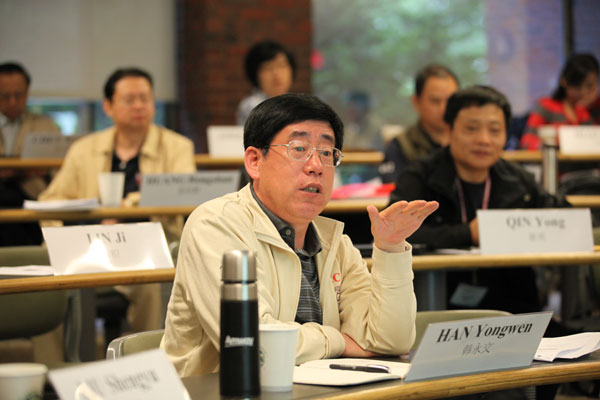
The high fliers, carefully vetted by the Central Organization Department, are sent to the Kennedy School of Government at Harvard University. The New World Fellows Program, established in 1998, has now tutored more than 550 Chinese participants from local and central governments and has expanded into a series of tailored and open-enrollment programs called the China Public Policy Program.
 |
|
Senior officials study at the Harvard Kennedy School via short-term executive training or independent research. Martha Stewart / for China Daily |
Many former students gained promotion on their return to China. They include the current Minister of Commerce Chen Deming, the governor of Shaanxi province Zhao Zhengyong, and Li Jiange, the chairman of China International Capital Corp.
Cases studies, such as Hurricane Katrina and the reform of property taxes in Indonesia, provided the students with a "tool kit" of public management. "So when they go home, they can choose the tool that's most appropriate to specific circumstances," said Julian Chang, executive director of the China Public Policy Program.
The academic curriculum is supplemented by visits to local, state and federal government organizations and tours intended to provide inspiration in solving public management issues. For instance, given rising concerns about China's rapidly aging population, the students were shown around apartments for the elderly in Boston.
They also visited Brigham and Women's Hospital, ranked eighth in the 2011 US News & World Report Honor Roll of America's Best Hospitals, and attended seminars on healthcare reform in Massachusetts. Others visited included the Boston Redevelopment Authority, a careers center in Boston and Bunker Hill Community College, one of the largest of its kind in the city.
Chang said the students learned from each other's experiences of working in different parts of China or the world. "In the customized programs, there's a lot of sharing of Chinese context. For example, someone from a big city may talk about his experiences, and those from the western regions with similar problems can learn from him. It's the same in the open-enrollment program. A lot of the learning takes place among the students. Their classmates may come from Russia, the Netherlands or France," he said.
Denis Simon, vice-provost for International Strategic Initiatives at Arizona State University, which has just finished training 30 officials from the Dalian Science and Technology Bureau, emphasized that Chinese civil servants need to "glocalize" themselves through overseas training.
"The purpose of this training is not to copy foreign practices per se. The main goal is to expose current and future leaders to new ideas and tools - some of which can be deployed in a Chinese context," said Simon
Fewer programs
The Chinese government forbids the use of training programs as an excuse for officials to travel overseas at the expense of the public. Organizers are charged with ensuring that study programs adhere strictly to the authorized schedule. If the rules are violated, the program's principal organizer is held responsible.
In recent years, the government has strengthened measures to monitor and evaluate overseas training programs. In Hubei province, for example, every participant is required to submit a report to the authorities within a week of the training program ending.
However, since 2008, a series of budget cuts has reduced the number of officials trained overseas. The cuts are part of official efforts to reduce the administrative cost of receptions, vehicles and overseas trips; areas that are considered a major source of corruption.
"Overseas training will certainly broaden the minds of Chinese officials, but the government should let the public know where the money is going and inform them of the necessity of these programs," said Mao Shoulong, professor at the School of Public Administration at Renmin University of China, who suggested that the local people's congresses should be involved in setting the budgets.
Related Stories
Integrity urged in civil servant recruitment exam 2012-10-15 17:15
Civil servants' blood donation 2012-09-18 15:53
District civil servants' finances made public 2012-08-29 07:26
Civil servants 'feel' good about health: survey 2012-06-20 20:20
5 punished over civil servant application scandal 2012-04-25 20:43
Civil servants serve as volunteers 2012-05-21 20:26
Top News
Xi emphasizes adherence to CPC Congress spirit
Top legislator urges implementation of congress spirit
Moderately prosperous China brings chances to world
Video