China explores expansion of grassroots democracy
(Xinhua)
Updated: 2012-11-05 14:01
 Comments()
  Print
Print  Mail
Mail  Large Medium Small
|
 |
|
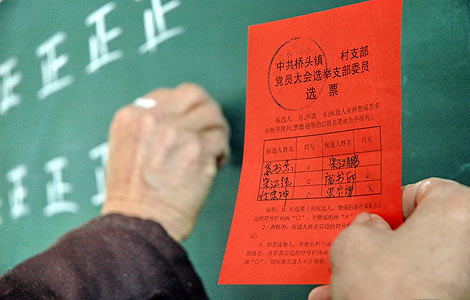
A man counts vote during an election of Communist Party of China chief at a village in Sheqi county, Hennan province in this Nov 26, 2008 file photo. [Photo by Song Tongjie/Asianewsphoto]
|
Wu Liutun, secretary of the Duqiao Village Committee of the Communist Party of China (CPC), told her that his signature did not count as it had before.
Wu asked Wang to get permission for the clinic from eight village deputies from the No 7 Group, one of the seven subsidiary units of Duqiao village.
Wang, a retired professor of Traditional Chinese Medicine at Henan University, based in the provincial capital of Zhengzhou, planned to set up a clinic where the No 7 Group is based, also her home village in the town of Baisha, Zhongmou county, and spend the rest of her life there.
But to achieve this, she would need to obtain approval from at least two-thirds of the village deputies.
"If she comes back, she will enjoy the same welfare as the other villagers, such as regular distribution of flour and cooking oil," said Wang Zhanjun, head of the No 7 Group. "Will the villagers agree, as their welfare is being shared?"
To avoid concentrating power in the hands of just a few people, Baisha introduced a villager representative system, or Villager Congress, in 2006. Unlike the past, when village heads decided everything, all major issues in the village are now decided by the representatives.
According to Chinese law, a village head is elected by all the villagers, but in most cases, a supervision system is not in place. Many village chiefs have continued to find ways to impose autocratic rule, having taken office via bribery or threats, said analysts.
Wukan Village, located in South China's booming Guangdong province, grabbed international headlines last year when the residents of the small village staged three waves of large-scale rallies over a period of four months to protest what they alleged were illegal land grabs, corruption and violations of financing and election rules among officials.
As the urbanization process has accelerated in recent years, much of Baisha's land has become home to factories. The distribution of the compensation funds for the occupied lands is largely controlled by the village heads.
In the village head election in 2005, only 15 of the 23 villages in the town were able to choose new leaders, for power was hard to be compromised, said Zhu Maitun, former secretary of the Baisha committee of the CPC.
The introduction of the villager congress system has allowed elections to proceed more smoothly. In the 2008 village head election, all 23 villages chose new leaders with the help of the village deputies, as conflicts were first eliminated among families.
Pan Changshui, 60, a farmer administered under the No 7 Group, had never imagined that he would one day have a say in village affairs, as he is not originally from the village.
Related Stories
CPC develops democracy over last decade 2012-11-05 10:53
China progresses in promoting well-being,democracy 2012-11-01 21:49
Official vows to promote greater Party democracy 2012-08-15 08:05
CPC elects younger,grassroot delegates to congress 2012-11-05 09:40
Reform must include grassroots innovation 2012-10-26 07:25
Video