The MAO legacy
(China Daily)
Updated: 2011-08-01 17:50
 Comments()
  Print
Print  Mail
Mail  Large Medium Small
|
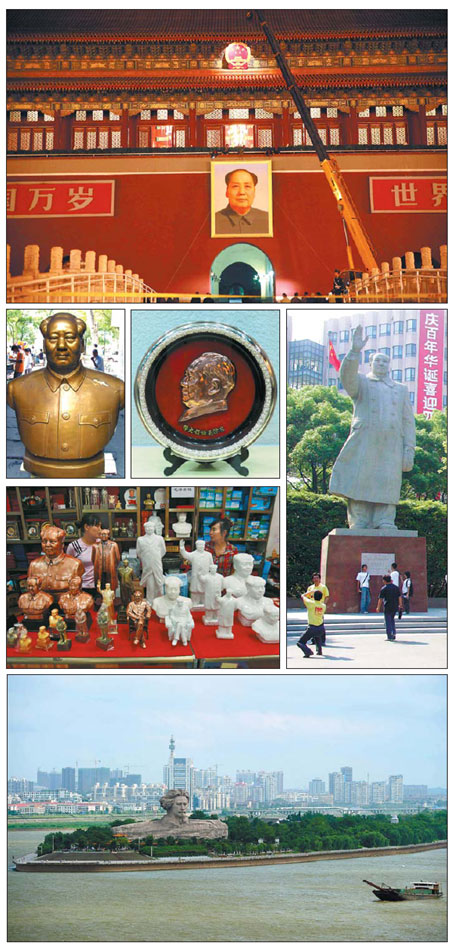 Chairman Mao's image means many things to many people. On Tian'anmen, it represents the glorious revolution he led. In busts, statues, medallions and various collectible figurines, his image is a reminder of the process of history. And in Changsha, a young Mao Zedong inspires with his example of turning ideals into reality. |
Cheng Wenjun is a photographer who has taken countless pictures of the statues through the years. He says the statues of that revolutionary period mostly portray the "Great Helmsman" as an older man, usually wearing an overcoat and either standing looking out into the distance or waving to an unseen crowd. Most are fairly formal, and serious.
The building of a Mao monument was equally serious business, and often it was a matter of patriotic pride and politics.
Hou Yibin, another photographer who has taken photos of Mao statues since the 1980s, says "sculptors of the statue were under great pressure, considering the job a significant political assignment."
In the early years of the economic reforms that began in the 1980s, many of these statues were quietly dismantled, and usually removed at night.
Even the famous statue at Tsinghua's second gate was torn down. In its stead, a sculpture of Mao in relief was placed in the main building of the university.
Photographer Cheng says Beijing now boasts about 20 statues of the great leader, while it is almost impossible to find one in either Tianjin or Guangzhou.
"Those statues which survived are modern historical relics."
New ones are also very different from the standard-issue Tsinghua replicas. On Dec 26, 2009, an enormous new sculpture of a young Mao Zedong appeared on Juzi island in the central city of Changsha.
It caught the country by surprise with its depiction of Mao as a young man, with a full mane of wind-swept hair. It also showed him seated, and is believed to represent 32-year-old Mao when he composed a poem about Changsha in 1925.
The head of the creative team for this innovation was Li Ming, dean and professor at the Guangzhou Academy of Fine Arts. He said his primary concern was "uniqueness and artistry".
"It was no longer a political assignment. We were free to let our creative juices flow and we were particularly concerned with differentiating it from past images."
The other difference was: Li and his team went after the project, wooing it for three years in order to win the bid. They felt it was a challenge, and "great allure for any artist". Li said their intention was to present the young Mao as a cool, good-looking idealist, rather than a god on a pedestal.
While this new look was praised for its innovative approach, it also took some brick-bats. Some web users compared it to the Sphinx.
The legacy that the Chairman leaves behind has already risen above hero-worship. The long queue in front of Chairman Mao Zedong Memorial Hall in Tianan'men testifies every day to his significance in China now.
There is a huge element of respect, and sometimes it borders on the religious.
A survey conducted by Beijing-based Horizon Research Consultancy Group in 2008 showed 11.5 percent of Chinese in 40 Chinese cities and towns worship Mao statues at home.
They pray for blessings in their career, studies, luck and life.
And in the tourist areas of trendy Houhai or Nanluoguxiang, T-shirts bearing Chairman Mao's image are popular souvenirs to take home.
His image may mean different things to different people, but in China at least, it represents a legacy that will last for a long, long time.
Video