Brief History of the Communist Party of China
(china.org.cn)
Updated: 2010-09-07 16:58
 Comments()
  Print
Print  Mail
Mail  Large Medium Small
The Zigzag Course of Socialist Construction (September 1956-October 1976)
After the basic completion of the socialist transformation, the Communist Party of China began to lead the people of various nationalities in large-scale socialist construction in an all-round way.
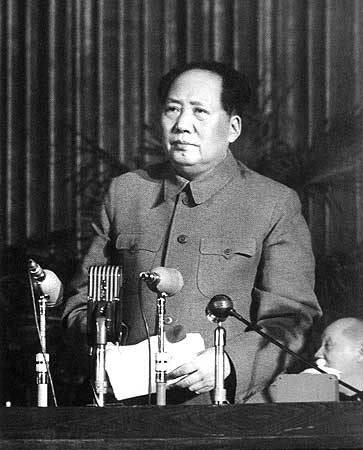
In September 1956, the Eighth National Congress of the CPC was held, at which the correct line of building socialism in all spheres was adopted. In April 1956, Mao Zedong gave a talk "On the Ten Major Relationships". In February 1957, he put forward the theory on the correct handling of contradictions among the people. By expounding upon such important theoretical issues, Mao Zedong made great contributions to the Party in the search for a road to build socialism suited to Chinese conditions.
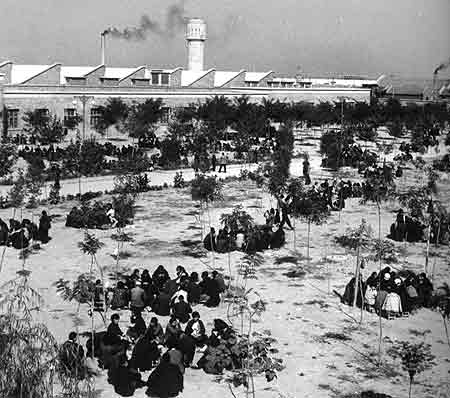
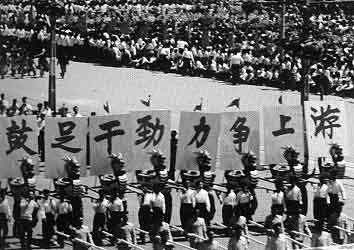
After 1957, "Left" deviations occurred in the Party's leadership on the issues of class struggle and the speed of economic construction. As a result, the cause of socialist construction suffered a serious setback, and the country experienced economic difficulties for three consecutive years. The Party therefore took measures to correct the "Left" mistakes and adopted the principle of "readjustment, consolidating, filling out and raising standards" for the national economy. At the same time, large-scale readjustments were made in policies concerning politics, ideology, culture and education. The new measures enabled the country to win continuous achievements in its socialist construction. A large number of qualified personnel were trained. Rich experience was gained. All this laid the material and technological foundation for the subsequent cause of socialist modernization construction. However, the "Left" mistakes in the guiding ideology of economic work were not totally corrected, while the "Left" mistakes in political, ideological and cultural areas were worsened, eventually leading to the outbreak of the "cultural revolution" in May 1966.
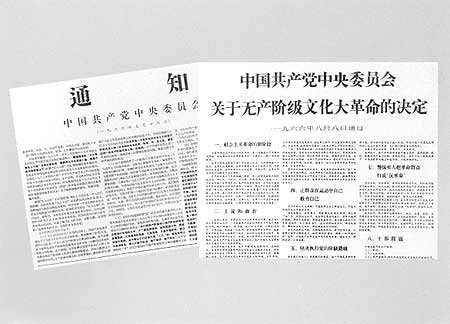
The "cultural revolution" was wrongly launched by the leadership and was exploited by counterrevolutionary cliques. It was a domestic turmoil that brought serious disasters to the Party, the state and people of all nationalities. However, during the "cultural revolution", the Party and people waged hard struggles against the "Left" mistakes and the two counterrevolutionary cliques headed respectively by Lin Biao and Jiang Qing. As a result, the damage of the "cultural revolution" was somewhat limited. Although the national economy and other causes suffered great losses, a certain amount of progress was still made. The nature of the Communist Party, the people's government and the people's army, as well as the society as a whole, remained unchanged. In the end, the Party, relying on its own strength, defeated the counterrevolutionary cliques headed by Lin Biao and Jiang Qing, overcame the turmoil and started a new historical era.
The zigzag course of China's socialist construction serves as an indication that it is a difficult and complicated cause to build socialism in China, where the economy and culture are in backward conditions. It also proves that the Communist Party of China and the socialist system have great vitality.
Video