Comments
  Print
Print  Mail
Mail  Large Medium Small
 |
|
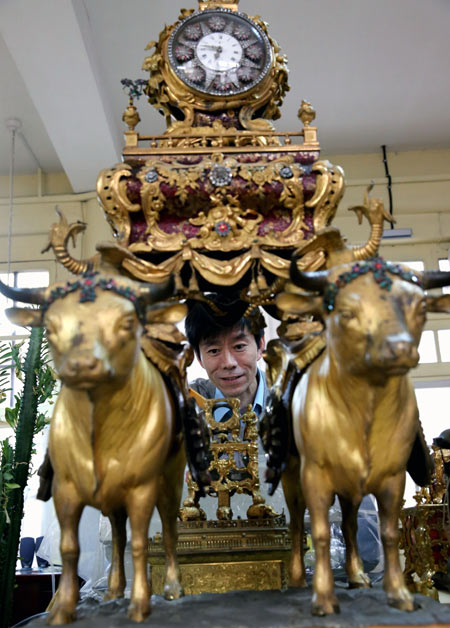
Master watch smith Wang Jin labors at his workshop in the Forbidden City.PHOTOS PROVIDED TO CHINA DAILY |
The top tier is the heart of the timepiece, although it is the least fanciful, and is a clear nod to the owner — the Emperor Qianlong of the Qing Dynasty who reigned between 1736 and 1796. Its whole design is based on a pagoda, complete with a soaring, swirling dragon rendered in abstract form.
As Wang ponders the immense effort that had gone into the mechanics and aesthetics of such a clockwork marvel, he says that the clock collections in the Forbidden City were more about satisfying imagination than measuring time.
"They were the playthings of the emperors and their courtesans," Wang says. "A large part of my job is focused on recreating the wow effect they once had on the beholders."
If polishing off the tarnish of time passed requires hard physical labor, then to solve all the engineering mysteries is sheer mental exercise.
"The Forbidden City holds the world's largest and most extravagant collection of antique clocks manufactured in Europe between the early 18th and 19th centuries. The fact that they were custom-made for the Chinese emperors meant that there is little or no information left in their countries of origin," Wang says.
Very often, the back panel of the clock would open to reveal a bewildering mass of tiny metal chains and wheels, the secret parts responsible for all the tricks.
It is a daunting sight for anyone, especially so for a 16-year-old Wang, first led through the door of the imperial palace by his grandfather, a keeper of the imperial library before his retirement in the 1970s.
"I took a glance and said to myself: Where should I start?" Wang is more inclined to smile away the previous 35 years than to dwell on the complexities of his apprenticeship.
"Restoring an antique clock is like feeling your way inside a dark underground maze. You let your knowledge and instinct lead the way," he says. "Sometimes, you hit a dead end and are forced to turn back. After you've tried and failed enough times, a faint glimmer of light would mysteriously appear ahead. You lock onto it, follow its lead, and go on until very suddenly, you find yourself bathed in bright sunlight."
Wang estimates that he has repaired and restored nearly 250 works, one sixth of the Forbidden City's total clock collection.
"When I'm working, I'm unconscious of time," he says, although he is very much aware of his place in history, a history that can be traced back more than 300 years.
"What separates the Forbidden City clocks from other imperial antiques is their East-meet-West nature."
Most experts agree that modern mechanical clocks were first introduced into China by Western missionaries around the early 17th century. During the reign of the Emperor Kangxi (1654-1722), they became so popular with the ruling elite that a special department within the Forbidden City workshops was established to assemble and repair the imported clocks, and to build new ones in a more expressly Chinese style.
Both foreign missionaries and their locally trained watch smiths were employed here.
As times changed, the fall of the Qing Dynasty in 1911 meant that treasures in the Forbidden City were either removed or left unattended. Some eventually ended up in Taiwan province with the exodus of the Kuomintang.
But the clocks stayed, and Wang guesses that it was their sheer weight and size that saved them from pilferage.
The knowledge and expertise also survived and continues. Wang was a disciple of a late master, and he, too, has taken an apprentice under his wings about seven years ago — a young graduate from Beijing's North China University of Technology.
"It's all about patience, and my teacher has plenty of that," says 30-year-old Qi Haonan.
Inside the Forbidden City, Wang's studio is only a few steps away from the parts of the Palace that are open to visitors and every morning, he has to cut through endless streams of visitors to get to his workshop.
Here, in his quiet corner, the solitude is punctuated only by the raven's cries overhead and the rhythmic tick-tock of the clocks. Occasionally, he may be distracted by a wandering toddler costumed in pigtails and imperial robes, or bemused by a flag-waving, fast-talking tour guide.
But it is a momentary diversion, and before long, he is immersed once again in an ordered world where every part and every gear contribute to perfect precision.
Contact the writer at zhaoxu@chinadaily.com.cn.

 Tornadoes destroy 500 homes in E China
 Fire in S China takes down food warehouses
 Hospital ship Peace Ark stops in Maldives
 Underwater kissing contest a wet affair
 China's youngest city glistens under palm trees
 Xinjiang tourism recovering
 Mourn for students in San Francisco air crash
 Double-decker bus caught fire in Shanghai
Copyright 1995 - . All rights reserved. The content (including but not limited to text, photo, multimedia information, etc) published in this site belongs to China Daily Information Co (CDIC). Without written authorization from CDIC, such content shall not be republished or used in any form. Note: Browsers with 1024*768 or higher resolution are suggested for this site.
License for publishing multimedia online 0108263 Registration Number: 20100000002731