 |
|
|
 |
|
|
|||||||||
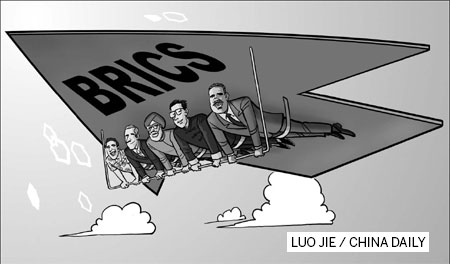
The heads of state of the top five emerging economies - Brazil, Russia, India, China and South Africa will attend the fourth BRICS Summit to be held in New Delhi, India, on Wednesday and Thursday.
After South Africa joined the group in April 2011, the economic size of BRICS grew to $11.7 trillion. The combined nominal GDP of the BRICS countries accounted for 18.5 percent of the world GDP in 2010. This increases to 26.7 percent if measured in terms of purchasing power parity.
Indeed, the economic gap between BRICS and the G8 is gradually becoming smaller. Excluding Russia, the rest of the G8 - Canada, France, Germany, Japan, Italy, the United Kingdom, and the United States - account for 38.3 per cent of the world GDP in purchasing power parity terms. This gap will become even less over the next few years as several G8 members are struggling to overcome from their chronic economic difficulties. The economic expansion of the BRICS countries, on the other hand, is expected to remain strong and steady.
BRICS is not only a group of the largest and fastest-growing emerging market economies, but also a gathering of three developing continents Asia, Africa and South America. It underlines the new locus of economic activity that is shifting steadily from North America and Europe, the developed "North", to the developing "South". It does not include any Organization of Economic Cooperation and Development countries, most of which are the high-income developed economies from North America and Europe that are currently deep in economic stagnation. With 42 percent of the world's population and enormous economic potential, BRICS symbolizes the new global economic "pole". In a larger geopolitical sense, it underlines increasing South-South cooperation, which is again a natural outcome of the changing global economic dynamics.
The financial crisis in Europe has established BRICS' emergence as a key source of global economic stability. There have been several discussions about BRICS offering assistance to Europe to help it ride out its difficulties, and with more than $4 trillion in foreign exchange reserves, BRICS is certainly capable of supporting Europe substantively. As yet, however, the group has not reached a decision on whether they should buy European bonds. But, whether they do or not, the group's future role in the management of global financial institutions and the global financial architecture will be major subjects of discussion at the forthcoming summit. The BRICS members have already contributed to the International Monetary Fund and a larger corpus with the IMF is expected to be able to provide significant help to Europe. Help from BRICS, however, is likely to be accompanied by the group's demand for a larger role in the management of the IMF.
Several European countries are major trade partners of the BRICS members, so it is in their own interests to see that Europe recovers quickly. However, it is clear that reviving Europe is going to take some time. In that case, the BRICS members should consider greater trade and investment cooperation between themselves. While it is still too early to think of a BRICS trade and investment framework, past instances of cooperation between BRICS members in the World Trade Organization, on common concerns such as agriculture for instance, can encourage them to explore collaborative possibilities. Efforts to facilitate greater trade and investment between the BRICS countries are also important given that the developed world is increasingly resorting to protectionism and inward-looking trade policies, which are limiting market access for several BRICS exports.
In the four years since the first BRICS summit in Russia in 2009, the gathering has moved beyond discussing just economic issues to other matters of global strategic significance. Beyond trade, economy and global governance reform, the summit is also expected to discuss other major issues of global significance including international security, terrorism, climate change and food and energy security. This is natural not only because the strategic importance of the BRICS countries has increased, but also because the rest of the world expects BRICS to play an important role in addressing major global issues.
The international community will therefore be keeping a close eye on the summit for signs of what the main representatives of the South agree to do in the future.
The author is head of development and programs and visiting senior research fellow at the Institute of South Asian Studies at the National University of Singapore.
(China Daily 03/28/2012 page9)

|
|
|
|

|

|