Shanghai to try using information-sharing system to better match organs, patients
Shanghai has started a trial project for the donation of human organs, which is expected to make better use of the small number of organs available.
On Tuesday, the municipal government said that 17 hospitals in the city will be the first to test the project.
 |
|
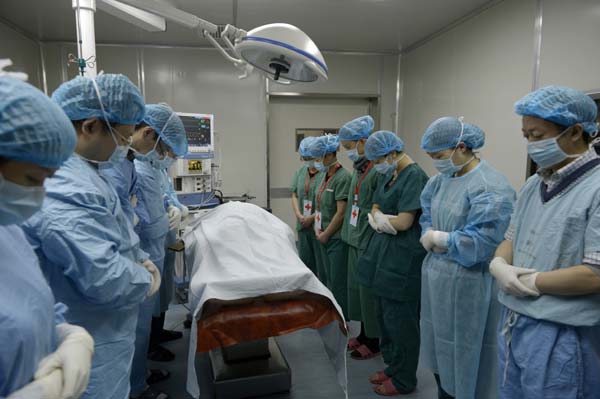
Doctors pay a silent tribute to Hu Xiaoxian, an organ donor, before performing transplant surgery at Luanchuan People's Hospital in Luanchuan county, Central China's Henan province, in this file photo. Zhang Xiaoli / for China Daily |
"All these hospitals are qualified and have certain characteristics that enable them to carry out the trial," said Li Minglei, vice-chairman of the Red Cross Society of China Shanghai Branch.
The trial will follow the guidelines of a national donation system established in 2010. It will also be carried out in accordance with an international practice that has all the information about the patients and donated organs recorded in an information-sharing system.
The project aims to ensure that the organs will be given to the patients who are most in need.
"The city has prepared for about two years before carrying out the organ collection and transplantation work. Compared with the current organ distribution situation, the new system will help to ensure a fair distribution of organs," said Li.
In the past, some hospitals received donated organs and arranged transplant surgeries using their own sources and without communicating with other hospitals, he said.
"Some patients in a serious condition weren't getting the organs they needed and were dying," Li said.
According to the Red Cross Society of China Shanghai Branch, a commission was also set up to provide guidance for donations and transplant surgery.
A diagnosis team will also participate in the evaluations of donors' deaths, a highly contentious issue.
Shanghai will follow the guidelines set by the national organ donation system stipulating that donations only be made after both cardiac death and brain death.
Data from the Ministry of Health showed that the ratio of human organs' supply and demand is severely imbalanced in China.
Each year, about 1.5 million people are placed on a waiting list for organ transplants, but only about 10,000 patients get organs.
Raising public awareness is at the top of the health authorities' list.
"In Western countries, there are established, comprehensive and mature human organ donation systems. And people accept them," said Wang Liming, a doctor from Shanghai's Changzheng Hospital, one of the 17 selected hospitals.
"In China, it will take time for people to accept the new idea. It's very important to establish a scientific and scrupulous system," he said.
Facing a shortage of organs, the country established a national donation trial project, which was put into operation in 16 provinces and cities in March 2010.
The national system, run by the Red Cross Society of China, aims to solve problems such as a shortage of organs and illegal transactions. It also began to encourage citizens to donate their organs after death.
Until Sept 30, 38 hospitals had received 1,279 organs from 465 donors under the system this year.
Huang Jiefu, vice-minister of health, said in Guangdong last month that China's reliance on organs from death row prisoners will end within two years, as the trial project has proven successful, according to a Xinhua News Agency report.
The country's first laws on the transplant of organs were issued by China's cabinet in 2007. The laws mainly aim to regulate the collection and donation of organs, and ban organizations and individuals from trading organs.
In 2011, amendments to China's Criminal Law also introduced three clauses dedicated to related crimes. Under the law, those convicted of organizing organ-trafficking activities face fines or prison sentences of more than five years, while people convicted of the forced removal of organs face punishment for homicide.
wanghongyi@chinadaily.com.cn



Copyright 1995 - . All rights reserved. The content (including but not limited to text, photo, multimedia information, etc) published in this site belongs to China Daily Information Co (CDIC). Without written authorization from CDIC, such content shall not be republished or used in any form. Note: Browsers with 1024*768 or higher resolution are suggested for this site.
License for publishing multimedia online 0108263 Registration Number: 130349