An equal education?
With future policy still unclear, parents with hukou in major cities are fighting to maintain the status quo.
Many argue that changing the rules would lead to a further overcrowding of metropolitan education systems and could open the door to abuse.
"Natives of Beijing, Shanghai and Guangdong, for our babies, let us be united in our fight against the policy," wrote one netizen as part of a discussion on Sina Weibo, a popular micro-blogging website.
Du, a Beijing mother and an opponent of a policy change, told China Daily she feels that the capital's education resources would struggle to cope with any more students.
"The city is not as resourceful as people think," said the 29-year-old, who was raised in Hebei province but obtained Beijing hukou when she attended college in the capital. She did not want to be identified for fear of reprisals.
"There are many problems with opening the gaokao to the children of migrants," Du said. "For example, powerful families may take advantage and move to Beijing or Shanghai just before the gaokao so their child can take it there. If they've received their entire education in another province where they simply focus on teaching for tests, how will Beijing students be able to compete?"
She was referring to the fact students who take the exam in Beijing and Shanghai can qualify for the cities' colleges with lower scores than if they take it in other provinces. For example, this year Peking University set the minimum score for Beijing science students at 654. In Shandong province, it was 698.
Hukou problem
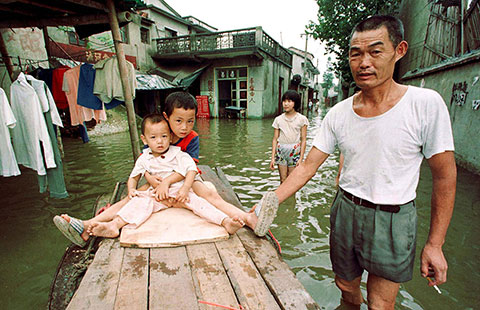
China had a migrant population of 221 million in October 2010, according to the National Population and Family Planning Commission, equal to two-thirds of people in the United States.
The sixth National Census found that roughly 7 million of them live in Beijing, accounting for more than 35 percent of all residents, while estimates by China Central Television in 2011 put the number of non-hukou children in the capital's primary and junior high schools at 478,000.
Chu Zhaohui, a senior researcher at the National Institute of Education Sciences, said the argument over the gaokao rules is a result of China's discriminatory hukou system. However, as a quick fix to achieve education equality, he suggested more power should be given to colleges.
"If universities had the right to recruit qualified students, they could pick up good students no matter where they come from," he said, although he conceded that it might take three to five years to build such a system.
Contact the writers at luowangshu@chinadaily.com.cn and caoyin@chinadaily.com.cn



Copyright 1995 - . All rights reserved. The content (including but not limited to text, photo, multimedia information, etc) published in this site belongs to China Daily Information Co (CDIC). Without written authorization from CDIC, such content shall not be republished or used in any form. Note: Browsers with 1024*768 or higher resolution are suggested for this site.
License for publishing multimedia online 0108263 Registration Number: 130349