Comments()
  Print
Print  Mail
Mail  Large Medium Small
Editor's note: Teng Aqing is a Beijing mother and a vocal opponent of allowing the children of migrant workers to take the national college entrance exam in her city. Her education blog has been viewed more than 4 million times. She spoke on condition of using her online pseudonym for fear of reprisals.
If the policy is changed and children from migrant families can take the same exam with native kids, it will harm both the capital and those rural regions.
I'm a third-generation Beijinger, born and raised, but I love the countryside. I rented a courtyard in Huairou (on the capital's rural outskirts) years ago and I love to stay there. So I can speak as a city and countryside resident.
As a Beijing native, I'm against such a policy change. The city cannot handle more people. It's already overcrowded.
I live near Third Ring Road, close to the Central Business District. My neighborhood was farmland 10 years ago. The city cannot expand indefinitely.
Xiaodian, a village close to the airport between the Fifth and Sixth ring roads, had only 4,000 residents a decade ago. It now has nearly 110,000.
The rapid growth in population also makes me worry about public security. I used to leave my apartment unlocked because I trusted my neighbors, who had lived here for years. But now we have a large number of temporary tenants. I don't have enough time to get to know them before they move away. The turnover is so fast, it makes me feel unsafe, even around my home.
Parents bring their children to Beijing for a better education. But the city's resources can't accommodate the soaring numbers.
Yes, Beijing did have the educational resources to accommodate the baby boom of the late 1970s and 1980s. But the student population has dropped in the 21st century, leaving more empty seats in schools. Many claim these seats should be enough for the children of migrant workers. But because there are fewer students, schools were merged.
My neighborhood used to have four elementary schools but now has only two. The same goes for middle schools and high schools.
Beijing's education resources are not as flush as people think. They shouldn't comment on this without research. I've been doing research on Beijing education for seven years. What I've witnessed is that the system can't accommodate more students.
I can also speak as a rural resident. As youth in the villages want to move to Beijing and fewer families stay in the countryside, there are fewer school-age children in these areas. Authorities have merged primary schools, making it difficult for left-behind children to attend.
My next-door neighbor in the Huairou village bought a car to drive their 7-year-old son to school last year. His home is about 9 kilometers from the new school. I've heard him exclaim, "Why is everybody leaving instead of building and developing their own home?"
I can't imagine how bad the situation is in remote areas.
Business people are mining villages for raw materials, leaving big holes behind them. They're selling the concrete and other materials to make money because fewer residents are there to oppose it.
Developed areas will eventually explode and undeveloped areas will be forgotten if people continue to move to big cities.
The solution is not to open seats for migrant children, but to develop local economies and balance resources.
Teng Aqing was talking to Luo Wangshu.
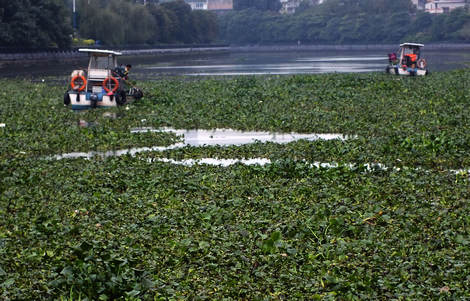
 Water hyacinth clogs Zhujiang River in S China
 NE China covered in wintry ice
 Mound of graves amid construction activity
 China, Belarus hold joint commando drills
 China's development not a threat: Xi
 China pledges $56 billion to cut air pollution
 Special: Cornea donors bring hope to others
 Large-scale air combat drill held in NW China
Copyright 1995 - 2010 . All rights reserved. The content (including but not limited to text, photo, multimedia information, etc) published in this site belongs to China Daily Information Co (CDIC). Without written authorization from CDIC, such content shall not be republished or used in any form. Note: Browsers with 1024*768 or higher resolution are suggested for this site.
License for publishing multimedia online 0108263 Registration Number: 20100000002731