Xu has looked beyond the explosion in the number of chain-store-like education institutes in the Western world and wants to optimize the layout of Confucius Institutes across the world.
"Although we do not open new Confucius Institutes on our own initiative, I would like to further increase the presence of Confucius Institutes in our neighboring countries as well as in the BRICS countries (Brazil, Russia, India, China and South Africa)," Xu said.
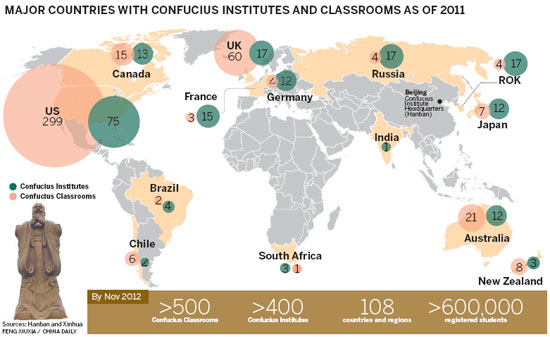
"The BRICS countries all have a big population. China's economic and political connection with them, and the neighboring countries, is getting closer, so we can focus more on these countries."
In recent years, she has also noticed a surge in demand for Mandarin teaching in these regions.
More and more students from Thailand, Myanmar and Laos have come to China to study Mandarin, while Mandarin is taught in some primary schools in Japan, the Republic of Korea and Mongolia.
However, promoting Mandarin in less-developed regions is not easy, and attracting qualified teachers and volunteers is one of the biggest problems.
"There are some practical difficulties for the teachers," Xu said, explaining that Mandarin teachers sent to some developing countries have to deal with certain problems.
Xu has increased the subsidy given to teachers and volunteers to encourage more of them to go to developing countries.
On the other hand, the fundamental solution is to help train local Mandarin teachers, she said.
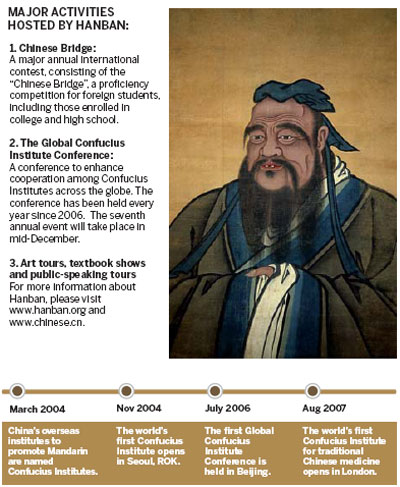
In November, the Confucius Institute Headquarters launched a new project, the Confucius China Study Plan, which supports foreign students seeking to complete PhD programs in designated academic areas of the humanities and social sciences in China, or sponsors experts and outstanding students for short-term exchanges.
"The project will help cultivate local teachers who could play a key role at the Confucius Institutes in their home countries, so that development of the institutes will be more sustainable," Xu said.
Confucius Institutes' work is misunderstood from time to time. Steven W. Mosher, a China specialist in the US, once called Confucius Institutes "Trojan Horses with Chinese characteristics" in his essays.
On May 17, without consulting China, the US government signed a controversial visa policy directive, according to which any teachers in US Confucius Institutes holding a J-1 visa would be forced to leave the US in six weeks.
The policy affected at least 51 Chinese teachers out of the 600 employed by the 81 Confucius Institutes across the US at the time.
Dozens of university presidents wrote letters to the US Department of State criticizing the policy directive. Eight days later, the US government changed the policy and promised it would not force the teachers to leave.
"The Confucius Institutes are definitely not Trojan Horses, since we are holding no weapons in our hands," Xu said.
"In 2011, only 12.5 percent of the institutes used textbooks published in China; the others used teaching materials composed in foreign countries, so we are not bringing any 'weapons' in our teaching.
"When we promote China's culture, we are not trying to force our values or traditions onto others. We teach foreign students how to say 'hello' and 'goodbye' in Mandarin, we tell them that when Chinese people meet each other, they usually say 'Have you had a meal'. Isn't that culture?"



Copyright 1995 - . All rights reserved. The content (including but not limited to text, photo, multimedia information, etc) published in this site belongs to China Daily Information Co (CDIC). Without written authorization from CDIC, such content shall not be republished or used in any form. Note: Browsers with 1024*768 or higher resolution are suggested for this site.
License for publishing multimedia online 0108263 Registration Number: 130349