Comments()
  Print
Print  Mail
Mail  Large Medium Small
Twenty percent of the Chinese population will be wealthy enough to be considered "affluent" by 2020, according to research by the management-consulting company Boston Consulting Group.
By then, 280 million people are expected to form the country's affluent class, wielding $3.1 trillion a year of purchasing power, an amount equal to 5 percent of global consumption, the company said.
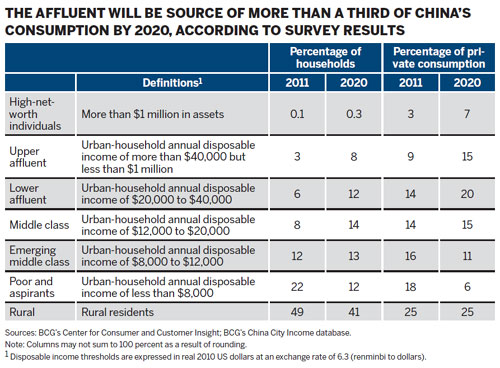
Boston Consulting defined people who have an annual household disposable income of $20,000 to $1 million as being affluent. By 2020, their consumption will be nearly equal to Japan's total consumption for the same year, 128 percent of Germany's and three times South Korea's, the report said.
Adjusted to take differences in purchasing power into account, the $20,000 starting point for the affluent class is equivalent to an annual household disposable income of $38,000 in the most-developed markets and is near to the medium household income of many developed countries, the company said in its report.
"Much attention has been paid to China's middle class and high-net-worth individuals," said Vincent Lui, a Boston Consulting partner and an author of the report. "But the affluent — (who are) richer than members of the middle class but not as wealthy as the super-rich — have spending habits and attitudes that are distinct."
The report said affluent consumers in China tend to replace their old belongings quickly as they pursue emotional gratification, status and recognition. It described them as being relatively sophisticated, a trait they exhibit in their willingness to travel abroad and try out new brands.
"A lot of affluent consumers buy luxury brands in response to social necessity and peer pressure," added Angela Wang, managing director of Boston Consulting.
"A consumer told me he thought he would be more respected for wearing luxury clothing brands. Another said he bought a Mercedes-Benz because he felt embarrassed to drive his Buick to attend a reunion of his old classmates."
The report, which was written using data obtained from a survey of 24,000 consumers around the world, also found that 72 percent of the affluent consumers polled had bought "popular" — meaning less-expensive — leisure clothes in the past year. But only 15 percent of them said they would buy a popular leather suitcase, an item that tends to be conspicuous on business trips.
The report said three quarters of those who make up the affluent class in 2020 will hail from relatively small cities. This emerging group, which will help drive consumption in China in the next decade, is expected to spend less time than average consumers on surfing the Internet to purchase items on e-commerce websites such as Taobao. They will instead be more likely to pay higher prices to make purchases on websites run by high-end brands.
Boston Consulting Group estimated the trading value of business-to-consumer websites will increase from the current 18 percent of all online trading to 40 percent by 2015.
Companies will find themselves catering for the so-called sugar generation, which is made up of the children of people now in the affluent class. In five years, those youngsters are expected to constitute 30 percent of that class, according to the report.
It said one of their main shopping interests will lie in buying products and brands that set them apart from others of the same age and they will be at ease with using the Internet.
One example of this behavior came with Sunday's "Singles' Day" purchasing spree. The day — set aside in honor of single people — saw many e-commerce companies offer promotions to boost their sales.
Their efforts were rewarded.
Alibaba Group, a giant in the industry, alone pocketed 19.1 billion yuan ($3.04 billion) in sales on the day, three times as much as it had on the same day a year ago. And the majority of the shoppers who bought goods on Alibaba's website were young.
"To tap this consumer market, businesses need to continually rethink how they position their brands and how they connect with consumers," said Justin Fung, a Boston Consulting Group principal.
The burgeoning purchasing power of China's affluent class, as well as that of high-net-worth people and the middle class, is a reflection of the increasing importance of domestic consumption to the country's economy.
In the first three quarters of the year, consumption of such products was the source of 54 percent of China's GDP growth during that time, marking the first time it has contributed more than fixed-asset investment to that figure.
"To have sustainable economic growth, China must move from having an investment-driven economy to one that is driven by domestic consumption," said Yu Miaojie, associate professor at the China Center for Economic Research at Peking University.
"To free up this power, China should improve its social safety net and reduce its tax rates."
Contact the writer at zhengyangpeng@chinadaily.com.cn

 Modeling contest part of China-US exchange
 Specially fertilized tea
 Simulator to support A320neo commissioned
 China's cultural sector sees steady growth in 2011
 Travel chaos after snowstorm hits NE China
 Inflation expected to rebound in November
 Grain output grows for 9th consecutive year
 White House-like buildings in E China city
Copyright 1995 - 2010 . All rights reserved. The content (including but not limited to text, photo, multimedia information, etc) published in this site belongs to China Daily Information Co (CDIC). Without written authorization from CDIC, such content shall not be republished or used in any form. Note: Browsers with 1024*768 or higher resolution are suggested for this site.
License for publishing multimedia online 0108263 Registration Number: 20100000002731