Comments()
  Print
Print  Mail
Mail  Large Medium Small
BEIJING - Zheng Chunxia, 37, still remembers the black "snowflakes" that flew out of the massive chimneys of the porcelain factory where her parents worked.
Zheng said she used to rub the "snowflakes" on her friend's face for fun, stopping only after their parents warned them that the black material was toxic.
In the 1980s, rapid industrialization turned Zheng's hometown of Jingdezhen, China's "porcelain capital," into a haze-shrouded city. Porcelain factories were built in the same areas as residential compounds, with large chimneys belching soot into the air.
The city consumed about 2 million tonnes of coal annually when porcelain production reached its peak in the 1980s, resulting in a discharge of 54 tonnes of hazardous particulate matter each month.
"A white shirt collar would turn gray within half a day," recalled Zhu Gangliu, deputy head of the city's environmental protection bureau.
Many of China's larger cities have experienced the same phenomenon. Although some have made efforts to move factories and other environmentally hazardous facilities into their outskirts, many cities are still contending with dangerous levels of air pollution.
Poor environments have not only sickened local residents, but also scared away potential investors. Reviving polluted cities has since become a significant problem in China's development.
The creation of a "culture of conservation" is expected to be on the agenda at the upcoming 18th National Congress of the Communist Party of China (CPC).
In a July 23 speech given to provincial-level officials, Hu Jintao, general secretary of the CPC Central Committee, described the promotion of conservation as a "strategic mission that will involve fundamental changes in our mode of production and way of life."
Jingdezhen is a model for the change that the CPC seeks.
In 1995, the Jingdezhen municipal government moved to limit the city's pollution by renovating kilns, dismantling chimneys and introducing centralized heating.
Porcelain factories have been moved out of the city's downtown area to suburban industrial parks with pollution control facilities, Zhu said.
Natural gas has replaced coal as the city's primary fuel source. Although a few chimneys remain downtown as a reminder of the city's porcelain heritage, the rest have been demolished.
Zheng, who now works as a quality inspector at a porcelain plant, no longer worries about wearing white clothing when she leaves her home.
"They use natural gas to fire the kilns, just like cooking at home. It is clean and non-toxic," said Zheng.
China's government has long been blamed for developing the country's economy at the expense of its environment, a situation not unlike that of countries that have fully developed their economies.
Developed countries also suffered from pollution while industrializing and subsequently spent large amounts of money to restore their environments, said Gong Yi, deputy secretary-general of the Environment and Development Research Center under the Chinese Academy of Social Sciences.
China is experiencing the same growing pains, Gong said.
Those pains may take some time to heal. As of June 2012, five of China's seven major rivers were polluted, while 33 out of 113 cities monitored by the Ministry of Environmental Protection did not meet national standards for air quality, according to statistics from the ministry.
Local residents in some areas have angrily spoken out, criticizing authorities for damaging the environment and endangering public health by approving new construction projects.
A massive protest was staged by the residents of the city of Shifang in southwest China's Sichuan province from July 1 to 3, with thousands of people demanding the local government halt the construction of a copper smelting plant that many feared would harm the city's water and air.
The local government announced on the morning of July 3 that construction on the plant would be stopped.
A similar protest occurred in the city of Qidong in East China's Jiangsu province on July 28, with thousands of angry residents taking to the streets to protest the construction of a water discharge plant that they believed posed an environmental risk.

 Modeling contest part of China-US exchange
 Specially fertilized tea
 Simulator to support A320neo commissioned
 China's cultural sector sees steady growth in 2011
 Travel chaos after snowstorm hits NE China
 Inflation expected to rebound in November
 Grain output grows for 9th consecutive year
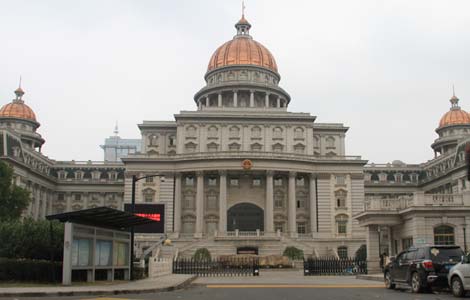 White House-like buildings in E China city
Copyright 1995 - 2010 . All rights reserved. The content (including but not limited to text, photo, multimedia information, etc) published in this site belongs to China Daily Information Co (CDIC). Without written authorization from CDIC, such content shall not be republished or used in any form. Note: Browsers with 1024*768 or higher resolution are suggested for this site.
License for publishing multimedia online 0108263 Registration Number: 20100000002731