|
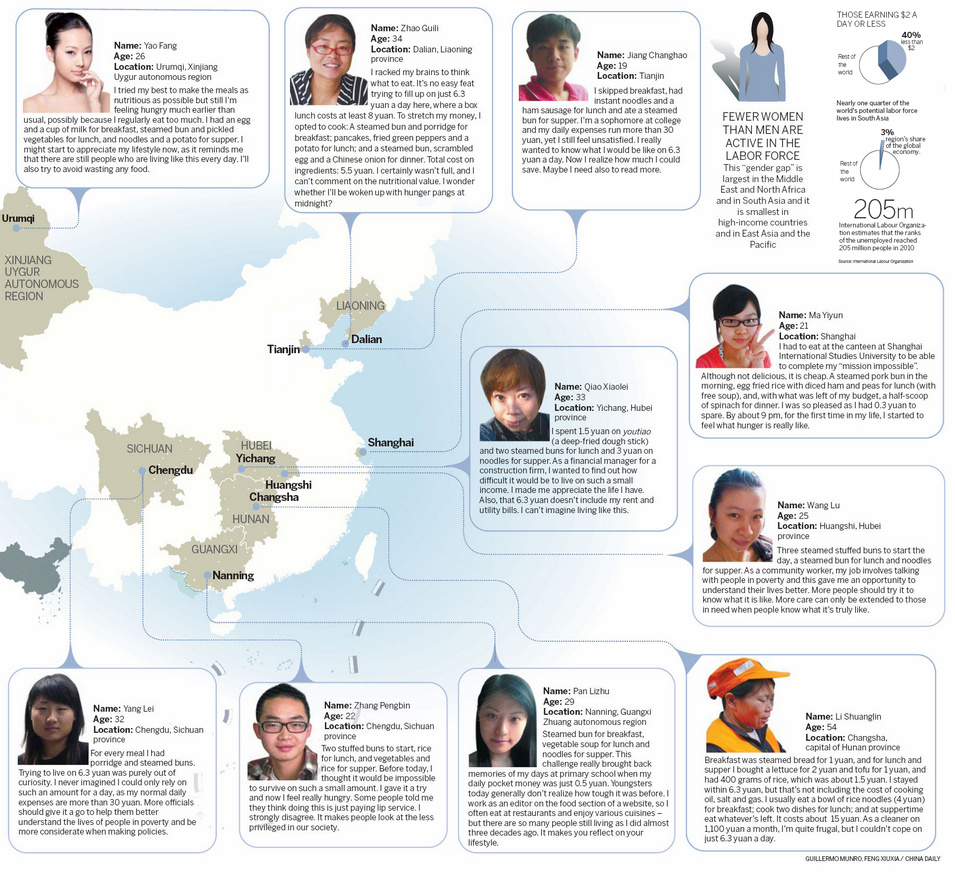
Can you imagine living on 6.3 yuan ($1) for a day? In China, residents with an annual net income of 2,300 yuan are categorized as people under the poverty line, which means their average expenditure for a day is 6.3 yuan. On Wednesday, the International Day for the Eradication of Poverty, China Daily picked 10 residents in different parts of China and let them tell you their ways to live on the sum for a day. |
|
|
Living on 6.3 yuan a day
|
|
 |
|
Villagers subsist on several yuan Wang Enguang's family of six began with a simple breakfast of rice and cabbage - leftovers from the day before. For lunch, the dish reappeared, this time with a little pork added. At dinnertime, they finished off what remained. The total cost of those three meals was 25 yuan ($4), which means each person's food bill was as little as 4.2 yuan that day. This is about as good as it gets for farming families in Wang's native Haohonghua, a village about 70 km from Guiyang, capital of Guizhou province. Guizhou is one of China's poorest provinces. About 45 percent of its 15.21 million residents live below the poverty line, largely because of poor transportation links, dwindling arable farmland and a lack of industry. >> |
|
|
Poor people in effort to improve lives |
|
|
More funds to pull people out of poverty
The government has promised more funds and favorable policies for poverty-stricken populations after lifting around 250 million rural residents out of poverty over the past 30 years. The country has also defined 11 regions, mainly the mountainous areas in the underdeveloped parts of China, as the key zones for poverty relief efforts. >> |
Development gives the poor a fresh start
The poverty line in Guangdong's rural areas was set at 2,500 yuan per capita net income in 2009. In the past three years, the provincial government has invested 14.8 billion yuan in fighting regional poverty, Li said. "The average annual income of Guangdong's impoverished people increased from 2,500 yuan in 2009 to some 6,100 yuan in 2011," Li said.>> |
|
Villages see success in improving lives Living in the poor and remote village, they know little about the outside world, and it was a little bit hard to communicate with them. Many young people choose to leave the village and go to cities to seek a job. But I also found an interesting trend in the nearby region of Haohonghua village, where five villages begin to plant commercial plants such as chayote, which can bring 10 times the income of traditional plants such as rice and corn. More importantly, it has cooperatives and the output was on a large scale. I learned that by targeting special market, many villagers gradually get out of poverty.>> |
Villages benefit from adopting new technologies Local farmer Li Rifan said that he did not continue planting peanuts and paddy rice, a business that he had been engaged in for more than two decades.Instead, the 51-year-old started to plant vegetables last year. Local authorities introduced a Dongguan-based company to set up a vegetable base in the village and organized some farming technicians to help farmers grow them. The products are shipped directly to Hong Kong on a daily basis. The move has been a success. Planting vegetables allowed Li to have earned more than 6,000 yuan so far this year, much higher than the income from planting peanuts and paddy rice. >> |
Copyright 1995 - . All rights reserved. The content (including but not limited to text, photo, multimedia information, etc) published in this site belongs to China Daily Information Co (CDIC). Without written authorization from CDIC, such content shall not be republished or used in any form. Note: Browsers with 1024*768 or higher resolution are suggested for this site.
License for publishing multimedia online 0108263 Registration Number: 20100000002731