Fighting corruption is one of the top priorities of the Communist Party of China and the Chinese government. People resonate to this priority, as reflected in the cooperative, outspoken and effective anti-corruption stance of the ever vigilant and active netizens.
In December 2010, the State Council formally issued the anti-corruption white paper: China's Efforts to Combat Corruption and Build a Clean Government. And the anti-corruption campaign will be a key issue on the agenda of the 18th National Congress of the CPC, which begins on Nov 8.
During the past decade, the Central Commission of Discipline Inspection of the CPC processed about 700,000 corruption cases. It will expose many more cases and prosecute many more people. Corruption must be checked and not allowed to contaminate and corrode CPC members and government officials.
Generally, fighting corruption requires trained eyes for telltale signs of corrupt practices. One key thing to look for is public officials' relation (possession, use and dissemination of or access) to luxuries, be they goods, services or both. In fact, succumbing to the lure of luxuries has become a key element of corruption in China.
Accordingly, China's anti-corruption agencies are educating and training agents about luxury goods and services to better fight corruption. Netizens are also playing their part in fighting corruption by being alert to the lure of luxuries to corrupt officials.
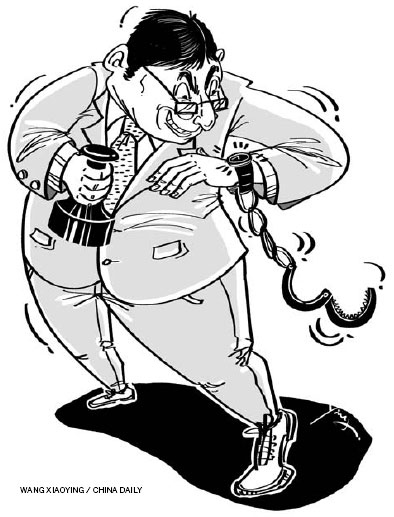
A recent example, widely reported on the Internet, shows how netizens and official anti-corruption agencies are cooperating. Looking at photographs, some netizens noticed that Yang Dacai, a senior Shaanxi province work safety official, had a repugnant smirk on his face while inspecting the site of a tragic transport accident. Checking other photographs of Yang, they identified that he sported 11 luxury watches on different occasions, which he could not afford given his level of income as a civil servant. This exposure led to official investigations, which found Yang guilty of corruption. He was sacked on Sept 21, 2012.
Yang's public display of luxury products is a case of inappropriate "conspicuous consumption", a socio-economic phenomenon of "wasteful and lavish consumption to enhance social prestige". Yang did not have to wear his pricey watches in public, but he was driven by vanity and a false sense of social prestige to do so. Many corrupt officials like Yang indulge in conspicuous consumption to gratify themselves with illegally earned money.
It was Thorstein B. Veblen, a Norwegian-American sociologist and economist, who coined the term "conspicuous consumption" in his book The Theory of the Leisure Class in 1899. The term describes the socio-economic reality of the then nouveaux riches in the United States, who, after acquiring sudden wealth, spent extravagantly on material excesses purely to show off and match the much envied lifestyle of the long-established rich. It was a case of showing off "new money" to "old money" to gain self-esteem.
By the 1920s, conspicuous consumption had become the prevalent culture in the US. F. Scott Fitzgerald fictionally documented this wayward 1920s culture in his celebrated novel The Great Gatsby. The novel is about corruption rooted in personal moral failings. It is about the corruption of people seeking social prominence through conspicuous consumption. In the value-neutral scholarly words of Veblen: " to gain and hold the esteem of men is not sufficient merely to hold wealth and power. The wealth and power must be put into evidence."
In separate scholarly and literary works Veblen and Fitzgerald both documented a universal condition of human weakness: Humans need to bolster self-esteem through ostentatious display of wealth and power, often through socially unacceptable means. This universal human condition has been present throughout history and across geographical boundaries. The verdict that "socially unacceptable means" must be eradicated is universal. The ways to eradicate them, however, are less universal, and are largely particular to a society.
In 30-odd years of reform and opening-up, China has lifted millions of people out of poverty and is moving toward achieving the ancient ideal of a "moderately prosperous" (xiaokang) society. Along the way, many people have become rich, sought social prominence or indulged in "conspicuous consumption", and many officials have wallowed in corruption. Being wealthy, seeking social prominence and even indulging in "conspicuous consumption" are, to various degrees, acceptable, but being corrupt can never be acceptable.
Realistically, given human nature, corruption in Chinese society today is like a cancerous pain, to snip it now will bring enduring joy, China has to remove the malignant growth in the best possible way.
China is fighting corruption and conspicuous consumption in three ways: formally, informally and culturally. The formal ways are documented in the State Council's 2010 anti-corruption white paper, and include systemic reform, enforcement of laws and regulations, education and international cooperation. The informal ways include creative contributions from people, for example, anonymous netizens.
On the cultural front, however, appeals should be made to the traditional social values of frugality and moral rectitude, long found in the practices of Confucianism, Daoism and Buddhism. Appeals also should be made to the modern spirit of Lei Feng's service to the people. This spirit combines values of traditional Chinese culture and contemporary socialist values. The three ways are interconnected.
China has to be patient in its fight against corruption, though, for as the country moves toward realizing a "moderately prosperous" society, the novelty of being wealthy will wear off, self-esteem will be less dependent on conspicuous consumption and corruption will be under greater control.
The author teaches philosophy at Montclair State University, US.



Copyright 1995 - . All rights reserved. The content (including but not limited to text, photo, multimedia information, etc) published in this site belongs to China Daily Information Co (CDIC). Without written authorization from CDIC, such content shall not be republished or used in any form. Note: Browsers with 1024*768 or higher resolution are suggested for this site.
License for publishing multimedia online 0108263 Registration Number: 130349