Mo Yan's Nobel will likely advance international interest in Chinese literature. Cecily Liu and Zhang Chunyan report in London.
Chinese writer Mo Yan's Noble Prize for Literature on Thursday might ignite an explosion of global interest in Chinese literature and lead to more titles translated into English, European experts say.
Chinese literature has already attracted international attention, but experts say translation remains a barrier.
"Hopefully, (the award) means more people will read Chinese literature and more work will get translated," says Michel Hockx, professor of the Languages and Cultures of China and Inner Asia from SOAS, University of London. "Many very good Chinese writers have been accepted globally for a long time already. Mo Yan is probably the most translated Chinese writer alive, with at least five of his novels made available in English over the past 20 years."
 |
|
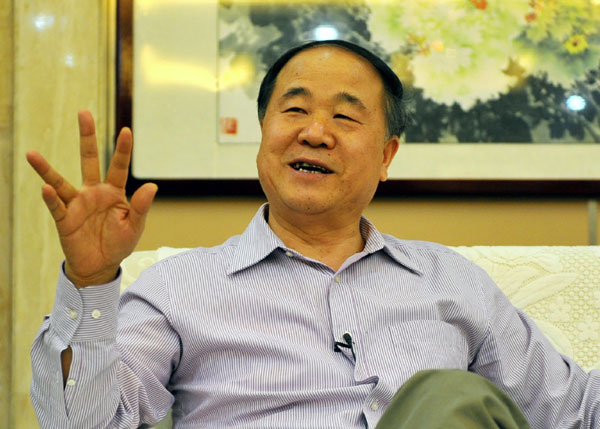
Mo Yan's Nobel Prize for Literature opens a new chapter for China. Many view it as a recognition of the country's growing global importance. Zhu Zheng / Xinhua |
Jonathan Ruppin, Web editor of bookseller Foyles, says Mo's win coincides with growing interest in Chinese literature and recognizes the talents of a distinctive and visionary writer.
"We are very excited by the fact that English translations of more of his books should now become available," Ruppin says. He made the comments after Mo became the first Chinese national to win the Noble Prize for Literature in its century-long history.
But as East-West cultural exchange has been booming, Chinese literature has been attracting growing attention in recent years.
Hockx explains: "(It's) mainly because there are many more opportunities for Chinese writers to visit other countries, to publish their work outside China and to interact with readerships abroad. At the same time, more and more people globally are learning Chinese and taking an interest in Chinese language and Chinese culture."
University of Oxford lecturer in modern Chinese literature Margaret Hillenbrand says: "The obvious reason for the growing global presence of Chinese literature is the growing global presence of China itself. People have come to realize that there is a serious knowledge deficit between China and its international counterparts - in particular, China knows incomparably more about Europe and America than the other way around - and reading Chinese literature is an effective, intuitive means of remedying that gap.
"And if the world is coming to Chinese literature, some might say that Chinese literature has taken steps toward the world, too."
In recent years, she says, Chinese writers as varied as Wei Hui, Yu Hua, Yan Lianke - and, of course, Mo Yan himself - have produced work that resonates more with international audiences than works from earlier periods.
Meanwhile, the notion of so-called "world literature" - the idea that works of literature can move beyond their origins and circulate globally - has gained academic currency. This will likely lead to more Chinese literature appearing in bookstores, libraries and university curricula, she says.
London's independent literary agent Toby Eady, who represents many Chinese writers, including Yu Dan, met Mo about 15 years ago in China.
Eady praised Mo as a great writer, adding that his contribution to literature is the equivalent of Dickens'.
But Eady says: "I still think Mo Yan's writing - and, to an extent, all Chinese writing - are not truly understood by Western readers because a part of Chinese literature is lost in translation."
Howard Goldblatt has done a good job in translating Mo's work, but the variety of Chinese vocabulary doesn't translate well into English, Eady says.
Translation is perhaps the most important dimension of Chinese literature's global acceptance.
University of Leeds' Chinese studies lecturer Frances Weightman says: "One reason why the reception of Chinese literature in the West has been problematic is the lack of people with the requisite language skills to read it in the original."
Hillenbrand explains: "The business of translating Chinese literature is booming as never before, and established figures are being joined by a talented cohort of younger translators. But this momentum needs to be maintained if Chinese literature breaks through permanently onto the global market."
She believes it's no coincidence that China's latest Nobel laureate is one of the most prolifically translated contemporary Chinese writers, Hillenbrand notes.
Hockx says: "We need more translators, especially foreign translators, who know good Chinese and can translate the work into their own languages in a way that foreign readers will appreciate and understand."
Good translators have been crucial to Mo's international success.
France is where his works were most widely translated and published outside of China.
The French interest in Mo's works was initially sparked by Zhang Yimou's film based on Mo's novel Red Sorghum. To date, 18 of Mo's books have been translated into French and published by two major publishing houses - Editions du Seuil and Editions Philippe Picquier.
Anne Sastourne, editor of the French translations of Mo's works at Editions du Seuil, says Mo is obviously intelligent but always calm and only speaks as needed.
"His openness, his human feelings and intellectual concentration can really be felt in his books," says Sastourne, who has met Mo several times. "We guess French readers are not very well acquainted with the Chinese world and may find it somewhat confusing. But still, they are very curious about and love (his) exotic, powerful and colorful style."
Editions Philippe Picquier's founder Philippe Picquier says it was Mo's "original voice, wild imagination (and) the poetic style of the storytelling" that won French readers.
His company has been publishing Chinese literature for 26 years and started to publish Mo's works in 1993.
Mo's novels Big Breasts and Wide Hips and Life and Death Are Wearing Me Out are among his most popular works in France.
Sastourne says Mo's Nobel will give Chinese literature more visibility in France.
"It will be a new step and should bring more readers to Mo Yan's works first and to others as well," she says.
Li Xiang in Paris and Fu Jing in Brussels contributed to this story.



Copyright 1995 - . All rights reserved. The content (including but not limited to text, photo, multimedia information, etc) published in this site belongs to China Daily Information Co (CDIC). Without written authorization from CDIC, such content shall not be republished or used in any form. Note: Browsers with 1024*768 or higher resolution are suggested for this site.
License for publishing multimedia online 0108263 Registration Number: 130349