Experts urge US presidential hopefuls to cool harsh campaign rhetoric
Harsh campaign rhetoric about China from both US presidential candidates is a big foreign policy mistake that will hurt bilateral ties, experts from each country said on Thursday.
The next American president should adjust to the rising economic power of China, welcome Chinese investment, manage any conflict and increase cooperation, they said.
 |
|
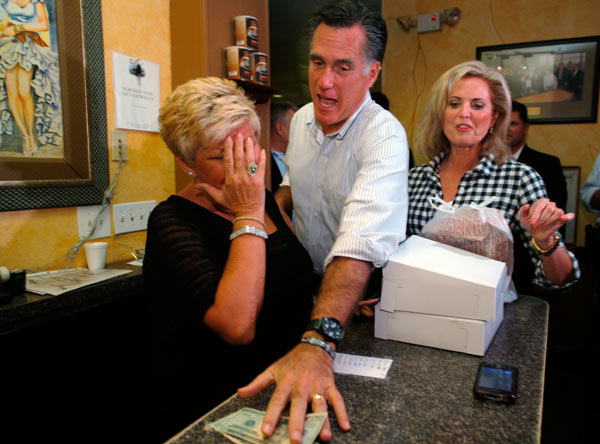
Republican presidential nominee Mitt Romney, with his wife Ann at his side, insists on paying for pastries and soup during a visit to La Tersesita Restaurant in Tampa, Florida on Friday. [Photo/Agencies] |
Challenger Mitt Romney has vowed that he would label China a "currency manipulator" if he makes it to the White House, and he reiterated during Wednesday's presidential debate that he would take on China in trade disputes as one of his five economic fixing plans.
Both President Obama and Romney have blamed China for American job losses and a trade deficit, and have also criticized each other for outsourcing jobs to China.
In a panel discussion on Wednesday afternoon before the first presidential debate, Henry Kissinger, former US secretary of state, said both candidates had been making irresponsible comments about China during the campaign.
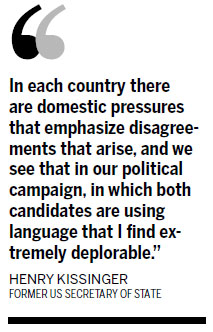
"In each country there are domestic pressures that emphasize disagreements that arise, and we see that in our political campaign, in which both candidates are using language that I find extremely deplorable," Kissinger said at the Woodrow Wilson Center in Washington.
"Both used the word 'cheat' as applied to China, in trade," Kissinger added, saying that "theoreticians" unschooled in the nuances of the US-China relationship "want to turn this into a crusade."
 |
"First of all, the issue is not currency manipulation," he said from the Carnegie Endowment for International Peace, a Washington-based think tank. "China's current account has been declining sharply. Its accumulation of foreign exchange reserves has slowed markedly, and its currency has appreciated over 30 percent since 2005, and it's continuing to appreciate."
What really concerns the US business community, he added, was intellectual property protction, market access and investment conditions.
"The second mistake is when you're trying to manage a difficult relationship, you don't make it more difficult," he said. "We are trying to have a constructive, strong relationship with China, and the candidates are talking about China in ways that undermine public support for the concept of a strong, cooperative relationship with China."
Elizabeth Economy, director of Asia studies at the Council on Foreign Relations, said both candidates have targeted China as a scapegoat for America's economic ills instead of engaging the Asian country in a "serious or substantive" manner.
"What should they be talking about?" she said. "I think the issues that we're going to discuss today - namely, how can the US enhance its economic position vis--vis China and the bilateral relationship? Are there opportunities for the United States and China to cooperate more on global issues? And does the US have it right when it comes to the pivot or rebalancing, as I guess it's now called more broadly within Asia?"
Yan Xuetong, director of the Institute of International Studies at Tsinghua University in Beijing, said the candidates' accusations of China "stealing" American jobs have a negative impact on China-US relations and undermine the cooperation between the two countries.
On security and military matters, former ambassador Roy said both the US and China have a legitimate right to develop defense, but the next American president should control the growing military build-up.
"The question is how much is enough?" Roy said. "I think the next American president and the current American president have a responsibility to try to bring an unconstrained competition over military capabilities between the Chinese military and the US military under control. Otherwise we are going to pour trillions of dollars into a competition which is not driven by the reality of the differences that we have with China, that simply don't justify that high level of spending."
On the attitude towards Chinese investment, experts agree that Chinese money is a good thing for the American economy, but Washington needs more transparency in its review process on foreign investment.
The Committee on Foreign Investment in the US has rejected several high-profile deals from China in recent years over concerns about national security.
Last Friday, President Obama blocked the proposed purchase of a wind farm in Oregon by a Chinese company on the grounds that it could damage America's national security interests.
"I think they (CFIUS) make mistakes," said Chas Freeman, chairman of Projects International and a leading China hand.
"They do it on a fairly routine basis, and they reflect fair amount of paranoia within the Beltway that's quite contradicted by attitudes in the country at large."
tanyingzi@chinadailyusa.com


Copyright 1995 - . All rights reserved. The content (including but not limited to text, photo, multimedia information, etc) published in this site belongs to China Daily Information Co (CDIC). Without written authorization from CDIC, such content shall not be republished or used in any form. Note: Browsers with 1024*768 or higher resolution are suggested for this site.
License for publishing multimedia online 0108263 Registration Number: 130349