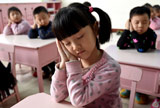
CHANGSHA - The death of a 3-year-old girl in central China has thrust unregistered kindergartens in the country's rural areas into the spotlight.
The news of Little Jiayi has stirred waves since the child was found dead last week in the kindergarten owner's car that was parked on the school's parking lot-turned playground in Enkou Village of Hunan Province's Loudi City.
An initial investigation suggested that lax management of the unregistered Xingji Kindergarten, referred to as a "black kindergarten" by local residents, contributed to the death of the preschooler. However, there are still various theories on her cause of death.
Media reports said the lively child who liked jelly and crackers most could have climbed into the unattended Beijing Hyundai, as the doors of the car had been left open. She may have then accidentally shut the doors and suffocated.
Investigations show that two of the six teachers in the kindergarten attended by 150 students daily are unlicensed. Cars are parked in the kindergarten's courtyard, which the children use as a playground.
"Everybody knows that there are a large number of safety loopholes in the kindergarten, a four-story building transformed from a civilian house," a local village official who preferred to remain anonymous told Xinhua.
He added that it was nearly certain that an accident would happen at the school eventually. "It was a question of time."
Little Jiayi's death has triggered public outcry, and people across the country are wondering how "black kindergartens" like Xingji can exist.
But unregistered kindergartens, most of which are located in China's rural areas, exist for a reason.
Statistics show that only 180,000 out of the total 280,000 children aged between three and five in Shaoyang City in Hunan, where the death of Little Jiayi was reported, attend registered kindergartens.
Only 20 percent of the city's private kindergartens, accounting for 95 percent of the total, are qualified according to the standards issued by Chinese education authorities.
"But if we shut down the unregistered kindergartens, most of which are unqualified ones, the kids in rural areas would have no kindergartens to attend at all," said an education official in Shaoyang, where parental absence is common among the children of migrant workers.
The official also preferred to remain anonymous due to the sensitivity of the issue.
Almost 70 percent of the children in Shaoyang are left behind in villages by their migrant worker parents who have gone to cities like Guangzhou and Changsha to make money.
Grandparents, who are often too old and too frail to go to urban areas, too, look after these children, but they are often unable to provide the children with much more than food and shelter.
The grandparents leave their grandchildren to kindergartens. Many have chosen the "black kindergartens," which are closer to home and less expensive, when registered kindergartens in the countryside are significantly insufficient.
Professor Pang Lijuan with Beijing Normal University believes that the large number of illegal kindergartens pose great potential safety hazards to the preschoolers.
"A lot of private kindergartens in rural areas do not have basic qualifications and are seriously understaffed," she said.
But the owners of the black kindergartens have their own arguments.
Li Xiaopeng, the former owner and teacher of an unregistered kindergarten in Lantian County in northwest China's Shaanxi Province, provided free access to education for local children.
"I want the children in the countryside to attend kindergartens, just like their peers in the big cities," Li, who died on his way to buy textbooks for the students, once told his family.
Professor Zhou Hongyu with the School of Education at Central China Normal University in Wuhan blamed the insufficient number of kindergartens in rural areas on the lack of preschool education investment, which only accounts for 1.2 percent to 1.3 percent in China's massive education budget that hovers near 2 trillion yuan (317 billion U.S. dollars).
However, changes are happening in the country that traditionally attaches great importance to education.
In Hongjiang District of Hunan's Huaihua City, all the preschoolers in rural areas are given free access to the three kindergartens built by the local government at a cost of 2 million yuan.
A special fund has been designated to provide free lunches and school bus services to all preschoolers in rural areas in Hongjiang, said Ni Renchang, head of the district's education bureau.


Copyright 1995 - . All rights reserved. The content (including but not limited to text, photo, multimedia information, etc) published in this site belongs to China Daily Information Co (CDIC). Without written authorization from CDIC, such content shall not be republished or used in any form. Note: Browsers with 1024*768 or higher resolution are suggested for this site.
License for publishing multimedia online 0108263 Registration Number: 130349