Comments()
  Print
Print  Mail
Mail  Large Medium Small
Authorities have updated a list of ancient guidelines on how to be a good son or daughter.
New additions to the latest version of the age-old Twenty-Four Filial Exemplars include calling home every week, celebrating birthdays with family and teaching elderly parents how to use the Internet.
 |
|
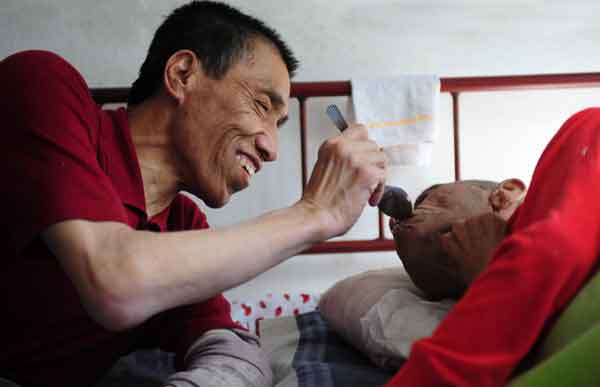
Guo Yurun, 58, feeds his father while discussing happy things to make him eat more in Shenyang, Liaoning province. Jiang Bing / Xinhua |
The All-China Women’s Federation and the China National Committee on Aging released the revised list on Monday.
Originally, the guidelines were written as fables that described dutiful children, such as the tale about a son who strangled a tiger to save his father.
The modern, more pragmatic additions have received a mixed reaction.
"I taught my mother how to use the Internet so she can chat with me. I’ve already fulfilled one of the new standards," said Zheng Li, a 27-year-old accountant.
An only child from a family in Jiangsu province, Zheng left home nine years ago for college and now lives in the United States.
"The old lessons are not really relevant to my life," Zheng said, adding that the updated version helps her understand her parents’ needs after being away for many years.
"My husband (who is also a Chinese) sees it differently though," she said. "He says the classic examples have stood the test of time. He believes in the classics."
Shen Xiaoyin, 50, from Chongqing, not only agreed with Zheng’s husband, but went one step further to dismiss the new additions as "useless".
"What good do they do? Children won’t come home more frequently just because these new guidelines have been released," she said.
Families play the biggest part in educating offspring about their duties, she said, adding: "My son (who studies at a US college) is a filial child because he has seen how we treat my parents, his grandparents."
Filial piety is a vital part of traditional Chinese culture. One common Chinese saying calls it "the most important of all virtues".
Authorities have paid great attention to encouraging the culture, including inserting an article urging children to frequently visit their parents in a draft amendment on senior citizen rights’ protection, which was submitted to the National People’s Congress in June.
Wu Yushao, vice-president of the China National Committee on Aging, said promoting filial piety is not trying to press the younger generation to be "blindly obedient" to their parents’ authority.
"It is about showing respect and love to aged parents and seniors, as aging is an accelerating trend in China," he said. "We urge adult children to provide financial support and sufficient care to their old parents."
However, Wu Zuolai, a cultural commentator at the Chinese National Academy of Arts, said the function of family has been weakened in China, especially in rural areas, because of the migration of the rural labor force to cities, which has left their parents living alone.
"Reminding people of the common sense about respecting the old is fine, but the government and all of society should make more efforts to perfect the healthcare and pension systems, as the latter can guarantee senior citizens live quality lives in the long run," he stressed.
Contact the writers at luowangshu@chinadaily.com.cn and hedan@chinadaily.
 Modeling contest part of China-US exchange
 Specially fertilized tea
 Simulator to support A320neo commissioned
 China's cultural sector sees steady growth in 2011
 Travel chaos after snowstorm hits NE China
 Inflation expected to rebound in November
 Grain output grows for 9th consecutive year
 White House-like buildings in E China city
Copyright 1995 - 2010 . All rights reserved. The content (including but not limited to text, photo, multimedia information, etc) published in this site belongs to China Daily Information Co (CDIC). Without written authorization from CDIC, such content shall not be republished or used in any form. Note: Browsers with 1024*768 or higher resolution are suggested for this site.
License for publishing multimedia online 0108263 Registration Number: 20100000002731