Comments()
  Print
Print  Mail
Mail  Large Medium Small
A new generation of Living Buddhas who are studying Tibetan Lamaism at top theological institutes are expected to become the eminent religious leaders of the future.
 |
|
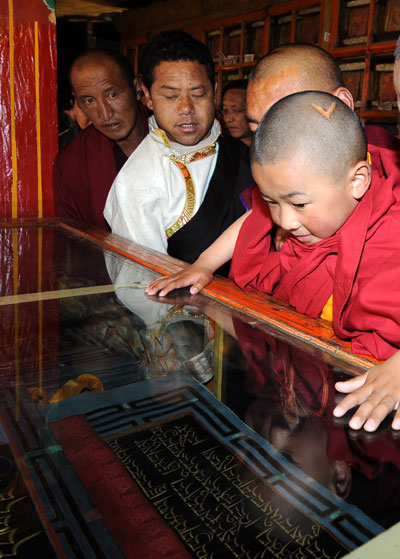
Dezhub Jamyang Sherab Palden (right) reads sutras at the Tibet Museum in Lhasa, capital of the Tibet autonomous region, on April 17, 2011. Jogo / Xinhua |
Twenty-two young Living Buddhas, including the 6th Dezhub Jamyang Sherab Palden, 7, and the 7th Reting Rinpoche, 15, are studying at the Tibet Buddhism University, Tibet's only regional-level Buddhist theological academy.
"The young Living Buddhas enjoy each other's company and they play and study together," said Dulkar Tsering, vice-president of the university.
The university opened in October 2011 and has 150 students. Its programs include Esoteric Buddhism, Exoteric Buddhism and Sanskrit for monks from all schools of Tibetan Lamaism.
"The students may have different backgrounds. They are of varying ages, come from different regions, and have different religious influences and economic status. But at school, they are equal as fellow students," Dulkar Tsering said.
Educating young Living Buddhas to become revered religious leaders was the next task facing China after the selection and recognition process of reincarnated Living Buddhas was standardized in 2007 by a regulation issued by the State Administration for Religious Affairs.
Some young Living Buddhas are tutored in their own monasteries, which may undermine their religious training because of inadequate resources, said Dulkar Tsering.
Now with all of Tibet's influential Living Buddhas under its roof, the Tibet Buddhism University tries to retain the model of traditional tutoring in monasteries, with 60 percent of the course devoted to religious training, and the rest to language, cultural and secular studies, he said.
It is important for Living Buddhas to communicate in local dialects and connect with believers from different areas in the Tibet autonomous region. It is also important they have the skills to engage in global dialogues during public appearances, Dulkar Tsering said.
Five monks from the university attended the 5th Beijing International Seminar on Tibetan Studies, which was held from Aug 2 to 4, attracting 267 scholars from China and abroad. The monks' participation was aimed at promoting Buddhist studies and gaining experience in front of an international audience.
The school tries to combine the advantages of traditional tutoring with modern skills. Located in Quxu county in Lhasa, it has advanced facilities, thanks to massive government investment.
"It is a matter of time until Living Buddhas from China will be proficient in multiple languages and knowledgeable in religious doctrines, Tibetan medicine and pharmacology," Dulkar Tsering said.
The reincarnation of the 5th Dezhub Rinpoche was the first major Living Buddha selected and enthroned after the 2007 decree came into effect.
Losang Dorje, born in 2005 in Lhoka prefecture of the Tibet autonomous region, was selected in July 2010 by drawing lots from a golden urn at the Jokhang Monastery in Lhasa, according to the rituals of Tibetan Buddhism and historical convention. He was enthroned as the 6th Dezhub Jamyang Sherab Palden after being approved by the central government and authorities in Tibet.
The young Living Buddha is studious, healthy and enjoys staying at the Tibet Buddhism University, said Dawa Tsering, director of the Buddhist Association in Lhoka prefecture. After the 5th Dezhub Rinpoche passed away in March 2000, Dawa Tsering led a search team and looked for a successor in more than 700 villages.
"I was personally involved in the process. I received great support from the central government and authorities in the Tibet autonomous region. Many well-respected monks helped me in the search and ensured religious rituals and historical conventions were adhered to," said Dawa Tsering in a speech during the three-day seminar on Tibetan studies in Beijing.
In China, about 1,000 Living Buddhas follow a reincarnation system. The reincarnation of a Living Buddha who has great influence, such as the Panchen Lama, needs to be confirmed and approved by the central government. For the reincarnation of Living Buddhas who have less influence, the State Administration for Religious Affairs will be consulted. And reincarnation of those with minor influence should be reported to provincial-level authorities, said Dulkar Tsering from Tibet Buddhism University.
Since the Qing Dynasty (1644-1911) the reincarnation of the 150 most important Living Buddhas has required approval from the central government.
Today, the number of highly influential Living Buddhas is still about 150 in China and the process of reporting to the central government is the same as it was in the Qing Dysnasty, said Li Decheng, director of the religious studies institute at the China Tibetology Research Center.
The lot-drawing ceremony from a golden urn has governed the selection of most influential Living Buddhas, such as the Dalai Lama and the Panchen Lama. The measure was first introduced during the Qing Dynasty to prevent Living Buddhas from appointing their own relatives or people close to them as successors, Li said.
By continuing historical customs, both the authority of the central government and the traditions of Buddhists in Tibet are respected, Li said.
Da Qiong in Lhasa contributed to this story.
liyao@chinadaily.com.cn

 Modeling contest part of China-US exchange
 Specially fertilized tea
 Simulator to support A320neo commissioned
 China's cultural sector sees steady growth in 2011
 Travel chaos after snowstorm hits NE China
 Inflation expected to rebound in November
 Grain output grows for 9th consecutive year
 White House-like buildings in E China city
Copyright 1995 - 2010 . All rights reserved. The content (including but not limited to text, photo, multimedia information, etc) published in this site belongs to China Daily Information Co (CDIC). Without written authorization from CDIC, such content shall not be republished or used in any form. Note: Browsers with 1024*768 or higher resolution are suggested for this site.
License for publishing multimedia online 0108263 Registration Number: 20100000002731