Comments()
  Print
Print  Mail
Mail  Large Medium Small
The percentage of children of young migrant parents in Beijing, Shanghai and Guangzhou who do not attend school is higher than the national average, according to a report on migrants under age 35 released by the National Population and Family Planning Commission.
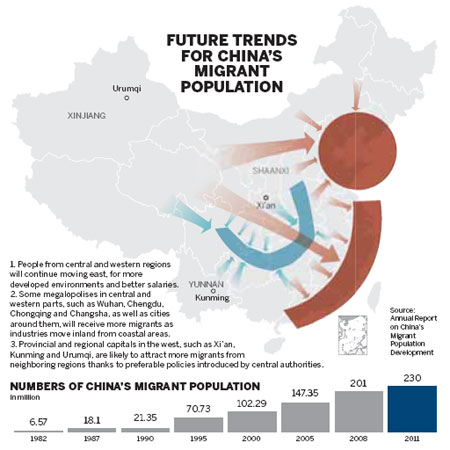
The commission looked at the lives of the "floating population" - migrants who do not acquire permanent resident permits, or hukou, in their new cities - of people younger than 35.
It found that more than 60 percent of these migrants in Beijing, Shanghai and Guangzhou brought their children with them.
In Beijing, 82 percent of those children ages 7 to 13 go to public schools, and in Guangzhou, 56 percent, according to the report.
However, 3.5 percent of those children in Beijing do not attend school; in Shanghai, 5.1 percent and in Guangzhou, 5.3 percent.
Nationwide, only 2 percent of the school-age children of the young floating population do not go to school, the report said.
Zhang Yi, a demographics expert at the Chinese Academy of Social Sciences, said around 75 percent of the floating population in big cities are migrants who leave rural areas to find manual jobs in cities.
Zhang said most floating population children who do not go to school are from migrant laborer families, who usually live on the outskirts of big cities, where education resources are limited.
"Migrant workers often change jobs and place of residence, and this would easily cause delays in their children's schooling," he said. "Some schools charge additional fees for the children of migrant families, which are beyond the families' means. This contributes to these children's comparatively high rate of non-enrollment in schools in big cities."
Although some private schools are established in city outskirts for migrant children, Zhang said, some of these have been demolished to make way for urban renewal projects, because most of these schools are set up in deserted factories.
Zhang suggested the government think twice before demolishing such schools because this is likely to increase the number of children dropping out of school.
Feng Xiliang, a labor expert at the Capital University of Economics and Business in Beijing, suggested allocating more education resources to city outskirts to close the gap between those and downtown areas.
"The government should consider basing the allocation of public resources on each region's population instead of the number of hukou-holders," Zhang suggested.
The report also said that in Beijing, the average per capita income of the young floating population is 3,280 yuan ($515) a month; in Shanghai, it's 3,000 yuan and in Guangzhou, 2,470 yuan. The national average is about 2,500 yuan.
Those who hold a bachelor's or higher academic degree earn 5,650 yuan a month in Beijing; 5,760 yuan in Shanghai and 6,570 yuan in Guangzhou. The national average is 4,600 yuan.
In those three cities, the proportion of the young floating population working in high-income and knowledge- or technology-intensive sectors such as finance, real estate, scientific research, education and health are much higher than the national level, said the report.
In those cities, they are more likely to find jobs via the Internet, it said, while elsewhere, they generally seek help from their families, relatives and friends, it said.
Contact the writer at chenxin1@chinadaily.com.cn

 Modeling contest part of China-US exchange
 Specially fertilized tea
 Simulator to support A320neo commissioned
 China's cultural sector sees steady growth in 2011
 Travel chaos after snowstorm hits NE China
 Inflation expected to rebound in November
 Grain output grows for 9th consecutive year
 White House-like buildings in E China city
Copyright 1995 - 2010 . All rights reserved. The content (including but not limited to text, photo, multimedia information, etc) published in this site belongs to China Daily Information Co (CDIC). Without written authorization from CDIC, such content shall not be republished or used in any form. Note: Browsers with 1024*768 or higher resolution are suggested for this site.
License for publishing multimedia online 0108263 Registration Number: 20100000002731