Comments
  Print
Print  Mail
Mail  Large Medium Small
City governments across China are hastily ordering checks on drainage systems, and several have unveiled plans for extensive upgrades, following the fatal floods in Beijing.
Shanghai, Wuhan and Guangzhou have announced multibillion-yuan projects, as officials look to allay residents' worries about cities' ability to handle heavy downpours.
Ma Yuandong, an official at Shanghai Drainage Administration, said the metropolis will invest 10.4 billion yuan ($1.63 billion) to improve 28 drainage systems before 2015.
Some systems will be replaced and others renovated to make them larger, Ma said.
"Most Shanghai streets can drain only 36 millimeters or less of rainwater an hour, though some areas, such as the airports, Expo site and Lujiazui financial district, can handle 50 to 57 millimeters (an hour)," said Liu Bo, a flood control official at the Shanghai Drainage Administration.
"The truth is, however, if Shanghai went through what happened to Beijing last Saturday, it wouldn't do any better."
The heaviest rainstorm in 61 years devastated Beijing on Saturday and killed 77 people, including 34-year-old Ding Zhijian, who drowned when his car got stuck in an underpass.
Authorities in the capital have conceded that the drainage system leaves much to be desired, as it can cope with only 30 mm or less rain per hour.
The capital's poor drainage system contributed directly to the death of Ding, said professor Li Tian at Tongji University's environmental science and engineering college, who is an expert on urban drainage system.
"Every underpass (in Beijing) is equipped with a water pump and that particular one couldn't help because all the nearby sewers were full, so the pump couldn't remove rainwater," he said.
Li warned that it will take time and not just money to guarantee an effective urban drainage system.
"A city needs a lengthy period to upgrade its drainage system, mainly because of concerns about holding up traffic and disturbing residents," he said. "Shanghai has spent the last 20 years improving the system in the old city and building new ones bit by bit in the suburbs. You've got to dig out the underground infrastructure in order to upgrade it."
Wuhan, capital of Hubei province, which also receives a lot of rain, began work last year to improve its sewer system by 2015 with an investment of 12.47 billion yuan.
The city government said it is installing non-watertight terraces, instead of concrete or cement ones, in public places such as squares, parks and sidewalks to lower surface runoff on rainy days. In addition, it will use sunken greenbelts to help lower surface runoff and underground reservoirs to help recycle rainwater.
Hu Liang, of Wuhan's Huazhong University of Science and Technology, said the situation has already improved compared with last year.
"The drainage system seems to be working more effectively this year - there was no sea of rainwater," he said.
However, Liu Huizi, of Wuhan University, said she does not believe the drainage system could handle a deluge like the one in Beijing on Saturday.
"A downpour this month turned our recreation grounds into a pond," she said. "The water was 90 centimeters deep at the school gates."
Guangzhou, capital of Guangdong province, which is frequently flooded during rainy season, is planning to build an underground tunnel stretching more than 100 kilometers into the downtown area to improve rainwater drainage.
Wu Xuewei, deputy director of the city water resources bureau, said construction cost of the tunnel is estimated at 6 to 8 billion yuan.
"We decided to build the tunnel deep underground after looking at the success of similar projects in advanced Western countries," Wu said. "City departments are conducting feasibility studies and seeking advice from experts at home and abroad."
Drainage system maintenance is also an important factor in protecting a city from floods.
Hong Kong renovates its drainage system before every rainy season from June to August.
Water cannons blast the sludge away to ensure the pipes are unobstructed. Closed-circuit TV cameras are installed where maintenance crews cannot easily reach to warn of damage or obstructions.
Hong Kong issued its highest tropical cyclone warning and had 300 mm of rain on Monday night and Tuesday morning, and there was no flooding in the city.
NASA satellite footage from Monday showed Typhoon Vicente brought mostly light to moderate rainfall, 20 to 40 mm an hour. However, some heavy rain (50 mm per hour) and towering clouds were seen around the center of the storm.
Contact the writers at shiyingying@chinadaily.com.cn and zhoulihua@chinadaily.com.cn
Zheng Caixiong in Guangzhou, Ma Yiyun and Li Xiuhui in Shanghai contributed to this story.

 Chinese photographer's starry sky image highlighted by NASA, PNAS
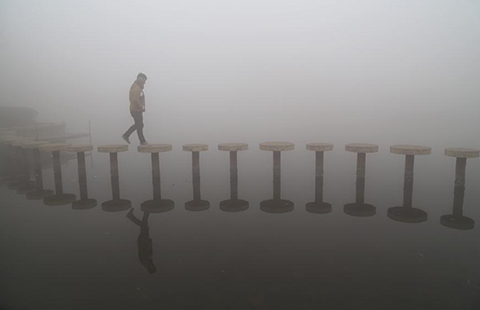 Heavy smog affects Chinese cities
 Girl becomes youngest Master of Memory
 One survivor rescued from Shenzhen's landslide
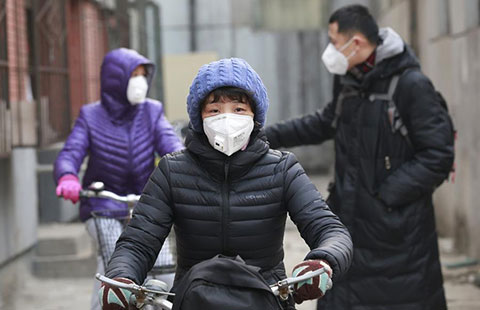 Life of a family amid Beijing's red alert smog
 Beijing chokes under red alert smog once again
 Beijing chokes under red alert smog once again
 Canadian college offers flying classes to legless girl
 80,000 pieces of marten fur seized by Shanghai customs
 Shanghai's most romantic graffiti wall
 At least 11 killed as storms, tornadoes hit southern US states
 Russia, India vow to enhance military, nuclear, anti-terror cooperation
 Yearender 2015: Heartstopping images of daredevils
 FIFA presents reform package for February congress


Copyright 1995 - . All rights reserved. The content (including but not limited to text, photo, multimedia information, etc) published in this site belongs to China Daily Information Co (CDIC). Without written authorization from CDIC, such content shall not be republished or used in any form. Note: Browsers with 1024*768 or higher resolution are suggested for this site.
License for publishing multimedia online 0108263 Registration Number: 20100000002731