Comments()
  Print
Print  Mail
Mail  Large Medium Small
Andes Resort International sounds like the kind of place where Premier Wen Jiabao would be staying on his current trip to South America. But the property is a mere hour's drive from central Beijing, and there are more surprises when you get there.
 |
|
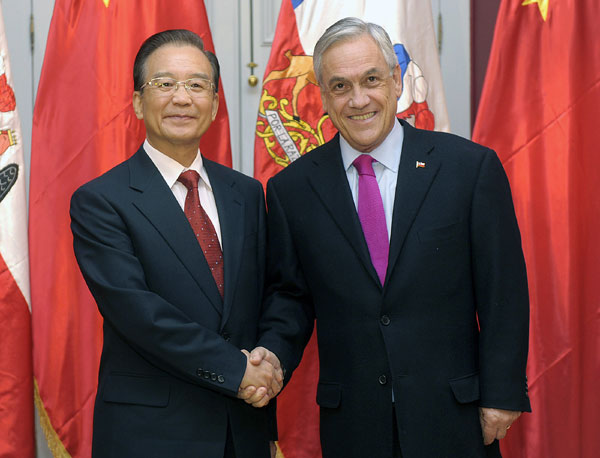
Premier Wen Jiabao meets Chilean President Sebastian Pinera during a banquet at La Moneda, the presidential palace, in santiago on Monday. [Photo/Agencies] |
The nation of Chile makes most people think of mines and wines — industries that represent the bulk its business with China and other countries. But on this suburban site in Jixian county, Tianjin, 23 hectares devoted to growing grapes and fruit trees present a fresh opportunity for trade.
Chile is a major producer of fruits and vegetables, and the demonstration farm on the resort grounds is a showcase for Chile's produce.
Thanks to a free trade agreement negotiated in 2006, Chilean fruit sales are expanding rapidly in China, says Nicolas Serrano Rolin, director of the Trade Commission Office of Chile in Guangzhou, Guangdong province.
The largest fresh fruit exporter in the Southern Hemisphere, Chile ranks behind only Thailand in fruit exports to China and No 1 in grapes, cherries, plums and apples, Rolin said. Total fruit sales surged 80 percent year-on-year to $441 million last year.
Most imported Chilean fruits are distributed from the Guangzhou Jiangnan Fruits and Vegetables Wholesale Market to major cities, including Beijing, Shanghai, Tianjin and Dalian, said Lin Yetao, a public relations manager of the market. Lin said Chilean fruit accounts for about 20 percent of the imported fruit his company handles.
Lin credits the growth to the free trade agreement — which cut duties on Chilean imports and made the country's fruits more cost-effective — and to the ever-increasing purchasing power of Chinese consumers. Plus, he notes, Chile is in the Southern Hemisphere, so it's harvesting and shipping fruits when they are not in season in China.
The demonstration farm, meanwhile, adds another dimension to the relationship, proving a chance to share Chile's fruit-farming expertise with China as the demand for fresh and safe food rises.
"The farming cultures are very different," said Alamiro Morales Mil, a Chilean agronomist who was recently in the apricot fields thinning the young fruits. Since there were a lot of visitors on this day, Morales was working in traditional costume: a flat-brim hat, colorful vest and ornate boots. He was plucking two of every three small green fruits off the branch, rolling them off his palm into a trash bag — a practice that makes his local work crew wince.
"Farmers here have traditions that were born in hard times," he said. "For them, the more grapes on a vine, the more plums on a tree, the better. The idea that you can add value by thinning, so the fruits that remain get all of the tree's energy, is pretty new here."
It takes a while, he said, to convince people that having fewer fruits that are bigger, sweeter and better shaped adds value that newly affluent Chinese will pay for. "The market decides," he added. "When imported fruits command good prices here, the Chinese growers want to get a piece of that business. And they should."

 Modeling contest part of China-US exchange
 Specially fertilized tea
 Simulator to support A320neo commissioned
 China's cultural sector sees steady growth in 2011
 Travel chaos after snowstorm hits NE China
 Inflation expected to rebound in November
 Grain output grows for 9th consecutive year
 White House-like buildings in E China city
Copyright 1995 - 2010 . All rights reserved. The content (including but not limited to text, photo, multimedia information, etc) published in this site belongs to China Daily Information Co (CDIC). Without written authorization from CDIC, such content shall not be republished or used in any form. Note: Browsers with 1024*768 or higher resolution are suggested for this site.
License for publishing multimedia online 0108263 Registration Number: 20100000002731