Comments
  Print
Print  Mail
Mail  Large Medium Small
Government's fiscal support key to promote advanced methods
Chinese health authorities are promoting advanced methods to test blood supplies to help ensure blood safety and reduce HIV infections via transfusions, said a senior health official on Thursday.
The genetic screening tests for RNA could be used at blood centers across the Chinese mainland.
|
 |
| Zhang Guihua (right), a retired worker, donates blood at the Beijing Red Cross Blood Center on Thursday, watched by actor Pu Cunxin, who is a voluntary blood donation promotion ambassador for the Ministry of Health. It was Zhang's 130th blood donation, and she was donating as part of the annual World Blood Donor Day. Zou Hong / China Daily |
Guo Yanhong, deputy head of the medical administration department of the Ministry of Health, made the remarks at an awareness-raising event to mark World Blood Donor Day, which falls on June 14 each year.
|
 |
The current widely used antibody testing method at Chinese blood banks can't detect HIV during the first three months of initial infection, and each year about 10 people on the Chinese mainland get infected via blood transfusions, according to a source with the ministry.
Meanwhile, donated blood can be transfused into a recipient within 10 days, according to Liu Jiang, head of the Beijing Red Cross Blood Center.
Under such circumstances, "the RNA tests could help largely reduce accidental infections and better secure blood safety and public health," Guo noted.
The RNA tests target genetic evidence of HIV and can detect early infections which the current antibody screening fails to spot.
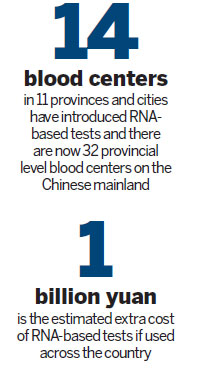
To date, more than 14 blood centers in 11 provinces and cities have introduced RNA-based tests and there are now 32 provincial level blood centers on the mainland.
"We are working closely to further expand the use of RNA tests nationwide," Guo noted, without giving a timetable.
Estimations put the extra cost of such tests at 1 billion yuan ($158 million) if used across the country.
According to Liu Jiang, the Beijing Red Cross Blood Center introduced the RNA test in November 2010, as required by the Ministry of Health, after it launched a pilot program in June 2010, under which the central government invested 157.6 million yuan ($25.7 million) in equipment purchases and training.
The center where Liu works pays 65 yuan more for each blood sample's RNA test. The other three blood banks in Tongzhou district, Yanqing district and Miyun county have not yet fully adopted the test, he said, citing a lack of funding.
Beijing has 400,000 blood donations each year, he said.
Conducting RNA tests on all the samples may require another 26 million yuan annually.
"We could hardly do it without the government's fiscal support," Liu said.
However, Liu firmly believed the benefit was worth the cost, for it significantly lowers risks from blood transfusion.
It can also shorten the window for detection of other infections like hepatitis and syphilis, said Xu Wen, an official of the blood donors recruitment office of the Beijing Red Cross Blood Center.
For HIV, the window period can be reduced to 11 days, adding that a zero-risk situation for blood transfusion doesn't exist anywhere in the world.
International studies have found that the risk of being infected with HIV from a blood transfusion is estimated between 1-in-38,000 and 1-in-300,000 depending on the amount of blood used.
Zhao Minggang, deputy director of the ministry's department of medical administration, urged people to be extremely cautious about blood transfusions given the risks of contracting blood-borne infections like HIV and hepatitis.
"This is a challenge faced by all countries. Blood transfusions should be a last resort," he said.
Du Weimin, a 22-year-old student in Beijing Sport University, who has donated blood six times since 2009, agreed, saying: "After all, risks exist. Hospitals should also be cautious about blood transfusions. I won't have a blood transfusion unless I need to."
In China, people who contract HIV and AIDS through blood transfusions have no legal claim for State compensation because the technology is deemed beyond the control of the government. Also, patients are asked to sign a consent form stipulating the risks before any such procedure.
Contact the writers at shanjuan@chinadaily.com.cn and wangqingyun@chinadaily.com.cn

 In pics: Installation process of world's largest telescope
 How much spice can you take?
 Yangtze River reaches flood stage for first time this year
 First 3D-printed house completed in Beijing
 Bus rushes out of expressway in North China, 26 killed
 14 dead amid heavy rain across China
 New uniforms for PLA's rocket force
 Ten photos from around China: June 24-30

Copyright 1995 - . All rights reserved. The content (including but not limited to text, photo, multimedia information, etc) published in this site belongs to China Daily Information Co (CDIC). Without written authorization from CDIC, such content shall not be republished or used in any form. Note: Browsers with 1024*768 or higher resolution are suggested for this site.
License for publishing multimedia online 0108263 Registration Number: 20100000002731