Comments()
  Print
Print  Mail
Mail  Large Medium Small
More legislative effort and concrete measures from employers are needed to help prevent and deal with sexual harassment in the workplace, experts have suggested.
Revised provisions that took effect in April have ordered employers to protect female members of staff from sexual harassment.
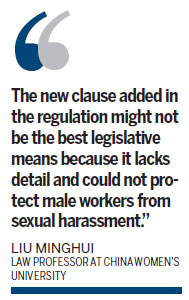
"The new clause added in the regulation might not be the best legislative means because it lacks detail and could not protect male workers from sexual harassment," said Liu Minghui, a law professor at China Women's University.
|
 |
Current laws forbid sexual harassment of women and say victims have rights to report to employers and sue related departments, but the laws do not give a definition of sexual harassment.
Liu suggests the Supreme People's Court add a judicial interpretation of sexual harassment.
"The interpretation should include the recognition of sexual harassment, the burden of proof, legal responsibility of employers who do not fulfill their duties to protect employees from sexual harassment, and any exculpatory circumstances," she said.
Liu said that, in general, sexual harassment means sexual words or deeds that are unwanted, and include verbal harassment, deliberate body contact and psychological harassment.
Psychological harassment refers to female workers' depression caused by constant wooing or even threatening, she explained.
A survey conducted by the Chinese non-governmental organization Womenwatch in 2009 found that 24 percent of workers polled said they had witnessed or heard of sexual harassment in their companies. Nearly 20 percent said they had been sexually harassed and 5.3 percent said they had harassed others.
Among the workers surveyed, 63 percent were women.
Liu, who participated in the Womenwatch's program, said she found that 44 percent of victims were harassed by colleagues, 33 percent by clients, 15 percent by superiors and 5 percent by subordinates.
As the detection and collection of evidence are still difficult, Liu suggests employers make rules about preventing sexual harassment, set up a department to receive complaints, define management responsibility, and map out remedial measures for victims and punishment for offenders.
"A mechanism should be set up to protect the privacy of sexual harassment victims and prevent offender's revenge," she said. "Management responsibility should also be clearly defined."
In General Electric China, for example, offenders receive warnings, demotion, removal or dismissal according to the severity of their actions, Liu said.
Punishment would also be given according to whether the offenders had previous records and their work performance. Offenders also must go through a course on sexual harassment prevention.
Lin Lixia, an expert at Beijing Zhongze Women's Legal Counseling and Service Center, said victims should first try to protect themselves, for example by shouting, and they should immediately report the incident to employers. If a severe situation happens, they should call police.
However, the Womenwatch survey found that only 45.6 percent of sexual harassment victims had warned offenders when harassment was happening and 34.3 percent of victims complained to employers.
Lin said her organization started a project to help enterprises set up more efficient sexual harassment prevention mechanisms in 2006. So far, six companies have established such mechanisms. The organization has also cooperated with the China National Textile and Apparel Council, where most workers are women, to provide courses to management and workers about the importance of sexual harassment prevention in companies.
Lin said most sexual harassment victims had lost their lawsuits because of the difficulty of collecting evidence and as well the country's imperfect laws and regulations in this regard.
In 2006, a female teacher in Southwest China's Chongqing lost her lawsuit alleging sexual harassment from her headmaster due to lack of evidence.
"Such cases suggest that the country should lay out more detailed and clear judicial interpretation and related laws and regulations to more efficiently protect workers from sexual harassment," said Lin.
chenxin1@chinadaily.com.cn

 Modeling contest part of China-US exchange
 Specially fertilized tea
 Simulator to support A320neo commissioned
 China's cultural sector sees steady growth in 2011
 Travel chaos after snowstorm hits NE China
 Inflation expected to rebound in November
 Grain output grows for 9th consecutive year
 White House-like buildings in E China city
Copyright 1995 - 2010 . All rights reserved. The content (including but not limited to text, photo, multimedia information, etc) published in this site belongs to China Daily Information Co (CDIC). Without written authorization from CDIC, such content shall not be republished or used in any form. Note: Browsers with 1024*768 or higher resolution are suggested for this site.
License for publishing multimedia online 0108263 Registration Number: 20100000002731