XI'AN - Archeologists unearthed more than 310 pieces of cultural relics from the No 1 Pit of the Mausoleum of Emperor Qinshihuang during a recent excavation of the mausoleum of the first emperor after China's unification.
The new discoveries include over 100 terracotta soldiers and war horses, two sets of chariots, as well as some weaponry, drums and a shield, said Yuan Zhongyi, a well-known archeologist who took part in the excavation work.
 |
|
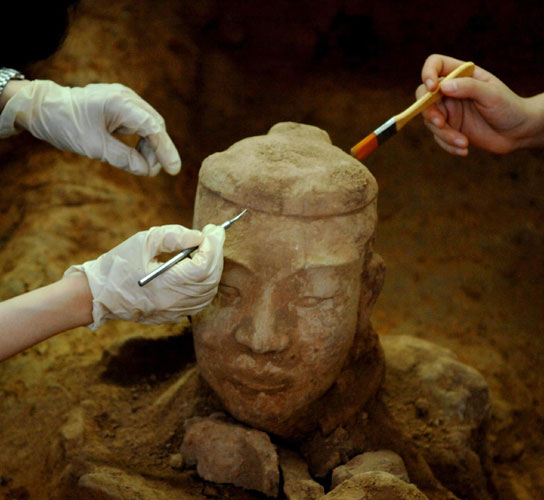
Archaeologists clean a newly found terracotta warrior at the No 1 pit of the Mausoleum of Emperor Qin Shihuang in Xi'an, capital of Northwest China's Shaanxi province, June 9, 2012. [Photo/Xinhua] |
The shield is an exciting discovery, because no shields had previously been found in the three pits of terracotta warriors, Yuan said.
The shield, about 70 centimeters in height and 50 centimeters wide, was found on the right side of one of the chariots.
Experts said the shield, which is twice as large as the bronze shield found among bronze chariots and horses, is evidence of the size of shields in the Qin Dynasty (221 BC-206 BC), because the bronze chariots and horses were produced to be half the size of real ones.
Vivid new discoveries
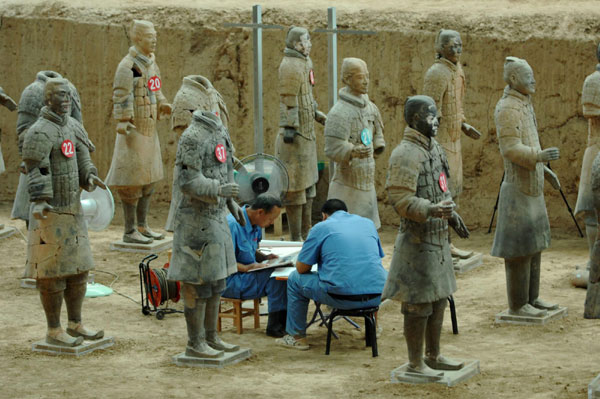
Of the 102 terracotta warriors unearthed from 2009 up to May this year, eight are officials and one is a senior official, said Xu Weihong, executive director of the excavation team.
The armor of the officials is much more complicated than that of ordinary soldiers, and the patterns on the officials' armor are more delicate and exquisite, Xu added.
Meanwhile, more terracotta warriors with colorful embellishments have been discovered this time, marking another important characteristic of this round of excavation.
"Strictly speaking, every one of the terracotta figures was decorated with various colors," said Xu, a researcher with the Museum of the Terracotta Warriors and Horses of Qin Shihuang.
There are three main reasons the color could have been stripped from the figures, said Yuan Zhongyi.
He said that some of the terracotta warriors were submerged in water and others were affected by the fire in the pits, which could both result in the loss of color. And the method for coloring Terracotta Warriors in the Qin Dynasty could also be to blame.
"At that time, craftsmen would paint raw lacquer on them before decorating. After so many years, the lacquer separates from the body, stripping off the color," said Yuan.
This time, the colors were much better preserved than in previous excavations, although the colored parts of the figures' faces and clothes are quite small.
The eyeballs of unearthed terracotta warriors are black and taupe, and one even has red eyes. More interestingly, eyelashes were painted on one of the figures.
Experts said that the newly-discovered terracotta figures have given weight to the saying that each warrior had a unique face and expression, and that the colors vary on different parts.
Underground performance troupe
In addition to the No 1 Pit, the 9901 Pit, covering 880 square meters in the southeast part of the Mausoleum of Emperor Qinshihuang, is another excavation site.
The terracotta figures unearthed from the 9901 Pit are totally different from the warriors and horses in the No 1 Pit. One terracotta figure is holding his left arm with his right hand, and another one is half-crouched.
According to Yu Chunlei, associate researcher at Shaanxi Archaeology Institute, the excavation of the 9901 Pit started in August last year, and one of the three tunnels has been opened and more than 20 terracotta figures have been unearthed.
Yu said the figures were badly damaged, so they were all discovered in fragments and archeologists have been busy repairing them.
The 20-plus terracotta figures were standing face-to-face. The figures facing south look quite strong and fat, while those facing north are much thinner, said Yu.
Meanwhile, a giant figure from the pit has attracted people's attention. The headless figure is 2.2 meters tall and its foot, which was found nearby, is 32 centimeters in length.
Experts said this figure is bigger than other ones in the pit and it could be as much as 2.5 meters tall if the figure's head were present, which would make him the Yao Ming, the famous Chinese basketball player, of the Qin Dynasty.
Zhao Huacheng, a professor of archeology from Peking University, said judging from the gestures and shapes of the terracotta figures and the appliances found in the pit, the figures were performers entertaining the emperor.
Zhao added that it remains unknown what, specifically, they were performing.
 |
|
Newly discovered terracotta warriors found at the No 1 pit of the Mausoleum of Emperor Qin Shihuang, June 9, 2012. [Photo/Xinhua] |


Copyright 1995 - . All rights reserved. The content (including but not limited to text, photo, multimedia information, etc) published in this site belongs to China Daily Information Co (CDIC). Without written authorization from CDIC, such content shall not be republished or used in any form. Note: Browsers with 1024*768 or higher resolution are suggested for this site.
License for publishing multimedia online 0108263 Registration Number: 130349