This is an isolated paradise where man and nature have lived happily together for generations. But besides being a favorite perch for photographers all over the world, the Honghe Hani Rice Terraces deserve recognition for more than just scenery for pretty pictures. The China Daily Sunday team of Wang Hao, Pauline D. Loh and Cang Lide takes to the hills and roots out the reasons why.
 |
|
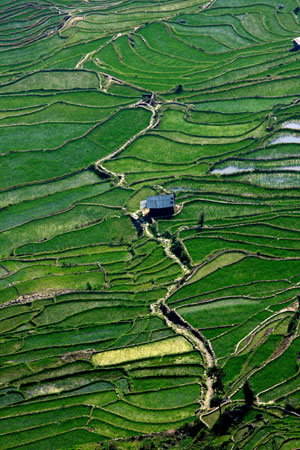
In May and June, the Honghe Hani Rice Terraces are a patchwork of fresh green. [Photo by Li Jincan / for China Daily] |
Every Hani has a song in his heart. It is these songs that have channeled the wisdom of their ancestors down through the ages. And now, while the rest of China spirals towards urbanization at breakneck speed, it is these songs that keep the Hani in harmony with nature and with themselves - almost like musical mantras for protection.
The Honghe Hani and Yi autonomous prefecture lies deep at the bottom of Yunnan province, in Southwest China. Go south past the prefecture and you hit the China-Vietnam border soon after.
It is this relative isolation that has preserved the Hani Rice Terraces and its dual heritage of an ethnic lifestyle intimately connected to the land, and the secrets of keeping an ecological balance that results in rice fields perennially rich and lush while the rest of the region thirsts in a three-year drought that is only just starting to break.
It takes a lot of rain to slake earth parched and cracked for so many growing seasons.
But, on the Honghe Hani Terraces, the land has been kept moist and fertile, and the only cracks that are appearing here seem to be threats on the horizon.
Local authorities and concerned community elders are grappling with the problems of a restless younger generation eager to try out the attractions of the big city.
These temporary temptations can do permanent damage to the Hani heritage if another type of balance is not brought about soon.
How do you tread the tightrope of giving the Hani all the advantages of 21st century life while helping them preserve a precious, proven self-sufficiency?
To solve at least some of these headaches, the Hani Rice Terraces Association was set up in 2003.
It is headed by Zhang Hongzhen, also the director of the Honghe Hani Rice Terraces agriculture board, a dynamic advocate of Hani culture who has gathered a dedicated team about her.
She personally led us on a two-day tour of the terraces, allowing us access to community leaders and villages that the casual tourist will never get.
One of the association's recent achievements had been to get the rice terraces listed, in June 2010, under the Globally Important Agricultural Heritage Systems Pilot Sites (GIAHS) of UNFAO, the United Nation's Food and Agriculture Organization.
The current buzz for the Rice Terraces is an application to get recognized as an UNESCO World Heritage Site as a cultural landscape.
Zhang, 48, is a Hani from the Red River and she quotes from the songs often. In fact, she had them documented and published in Chinese from the original Hani language, and then translated into English. The volume is called the Songs of the Four Seasons.


Copyright 1995 - . All rights reserved. The content (including but not limited to text, photo, multimedia information, etc) published in this site belongs to China Daily Information Co (CDIC). Without written authorization from CDIC, such content shall not be republished or used in any form. Note: Browsers with 1024*768 or higher resolution are suggested for this site.
License for publishing multimedia online 0108263 Registration Number: 130349