|
|
|
 |
|
|
|||||||||
China has been paying a hard price exploiting its rare earths resources. It’s said that a year’s gold is sold at the price of cabbage.
Jiangxi province, rich in rare earths minerals in China, earned 32.9 billion yuan ($4.89 billion) from this industry last year, but it has to spend 38 billion yuan to tackle the environmental pollution in Ganzhou, one city in the province, according to an Economic Information report.
Huge price to pay
The way to get rare earth materials is devastating to nature and the damage is irreversible. It used to be described as the "remove mountain campaign" in Ganzhou, Economic Information reported.
A traditional process to get this mineral will eradicate trees and grass first and peel off topsoil of the earth. What's more, the waste water coming from the chemical reaction is full of ammonia nitrogen and heavy metals, which are extremely harmful to people's health and the nature.
 |
|
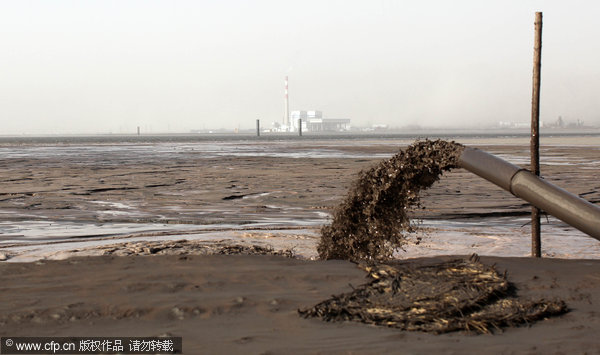
A "lake" forms from the processed waste left after exploiting rare earths elements in Baotou, Inner Mongolia autonomous region on Nov 26, 2010. [ Photo/CFP] |
The paper quoted Su Bo, vice minister of Ministry of Industry and Information Technology of China, that the soaking-mine method is adopted more widely now. Workers pour large amounts of vitriol ammonia ((NH4)2SO4 into the mine mount, then distil the rare earths minerals after certain reactions. But that poisonous liquor will stay and may pollute the underground water.
"When I saw so many forests turn to dead bare hills because of rare earths exploiting. I only feel sad," Sun said, "The hills are not what you see. It’s deteriorating from within."
Illegal tapping on rare earths
Large groups of unauthorized exploiting the trade are also make the pollution problem worse, China Business News reported.
The state-run companies only take up a small part of the rare earths productivity, but they are under the toughest environmental regulation. Many small unauthorized groups are off the limit, said an unnamed manager of a large rare earths company.
"After making some profits, they run away. With the environment being polluted, you never know who really did it," he added.
Export restrictions are necessary
Since China tightened its control on the rare earths industry last year, the price of rare minerals soared and has provoked a series of international trade frictions, China Business News reports.
On March 13, the United States, the European Union and Japan jointly challenged China's restrictions on exports of rare earth materials, and requested consultations with China under the World Trade Organization (WTO) framework, the report said.
 |
|
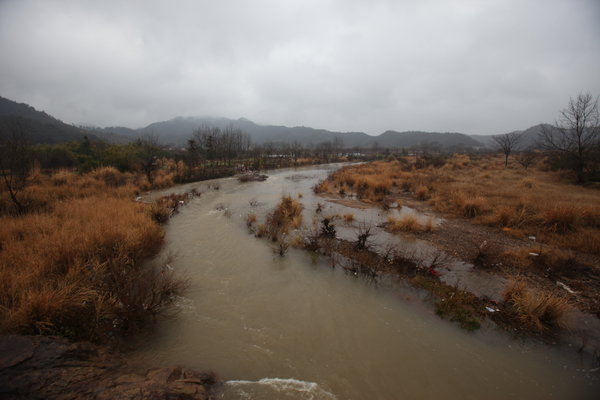
Withered plants along a river polluted by rare earth processing in Ganzhou, Jiangxi province on Feb 17, 2011. [ Photo/CFP] |
Besides, countries like the US, Australia and Canada are re-entering the exploitation business, the paper quoted Zhang Anwen, deputy secretary of the Chinese Society of Rare Earths as saying.
Su Bo told the paper the state-run rare earth companies could retrieve 60 percent of the materials, private companies 40 percent, illegal ones may only get five percent. There are no effective ways to solve the pollution it brings.
"Protecting the natural resources and people's health is our responsibility, not an excuse to limit rare earths exports, purported by the EU," Su said, "We will not loosen the control on the industry."
Industrial Secret Ingredient
Rare earth materials, a group of 17 key elements used in high-technology products, are called as "Industrial secret ingredients". They are what make your cell phones vibrate with a tiny but intensified magnet or harden a porcelain knife sharp enough to cut a steak. They are been widely used in high-technology products.
However, rare earth elements are typically dispersed and not commonly found in concentrated and economically exploitable ways.
Inner Mongolia autonomous region and Jiangxi province are the regions with the richest rare earths materials in China.
|
|
|

|

|

|