|
|
|
 |
|
|
|||||||||
How to dispose of used batteries has long been a concern of Feng Xiao.
Despite being taught that used batteries should be disposed of separately to help prevent heavy metal pollution, Feng still finds it a headache to deal with them.
|
 |
|
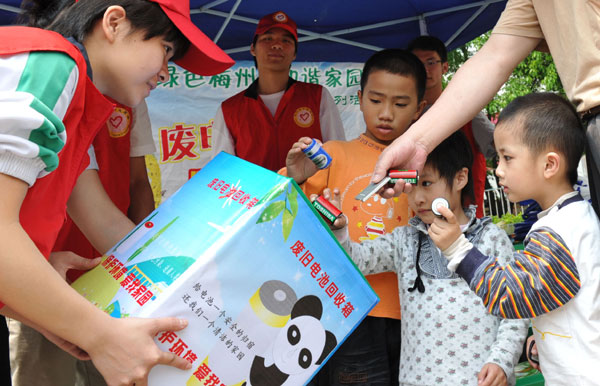
Children put used batteries into a recycling bin during an environmental protection campaign held in April 2011 in Meizhou city, Guangdong province. Zhong Xiaofeng / Provided to China Daily |
"There's nothing I can do because I can't find places to toss aside used batteries," said the 25-year-old Beijing resident.
In contrast, Du Shaozhong, former deputy director of the Beijing environmental protection bureau, has no problem getting rid of used batteries.
"It's safe to bury used batteries with other household waste and there is no risk of them contaminating the soil," Du said.
He said the amount of mercury contained in batteries in China is very low, following a national ban, and they did not need to be dealt with separately.
A regulation issued by the General Administration of Quality Supervision, Inspection and Quarantine in 1997 stipulated that sales of alkaline zinc-manganese dioxide batteries containing more than 0.0001 percent of mercury should be banned from the beginning of 2006.
However, despite the convenience of disposing of used batteries with other waste, few people favor the practice due to concerns over heavy metal pollution.
"I would rather store them at my place than bury them in the ground," said Feng.
"Not all batteries are free of mercury," said Chen Liwen, a researcher at the Green Beagle, an environmental protection non-governmental organization based in Beijing.
"Even though a single battery contains very little mercury, the heavy metal contained in a large amount of batteries remains inestimable."
Although the amount of mercury used in batteries has dropped from 582 tons in 1995 to 140 tons in 2009, the battery still contains the biggest amount of mercury among all household garbage, said Mao Da.
Mao is a Phd student from Beijing Normal University and member of the EnviroFriends Institute of Environmental Science and Technology.
Of the 8 billion batteries used every year in China, only 2 percent are recovered.
"Even if all the batteries are mercury-free, the other heavy metals they contain, including manganese and zinc, are also a potential hazard to the environment," said Mao.
So, too, are the "button" batteries widely used in products, such as toys, remote controls and musical greeting cards. They contain a high level of mercury and can easily pollute the environment, if disposed of casually, said Mao.
Instead, used batteries are a huge resource of heavy metals, if collected and reused, he added.
"Whatever you do, mixing and burying used batteries with other waste is never the best treatment," Mao said.
In response, Du said burying used batteries with household waste means the government can concentrate efforts on regulating the disposal of higher polluting batteries, such as those used in electric cars.
"It's not that the government is not acting. It is just trying to crack the nuts from the hardest one down.
"The government will start dealing with all batteries at the right time in the future," said Du.
However, Mao said the government should think further about the environmental risks caused by seemingly non-polluting batteries.
"We cannot say for sure that other heavy metals contained in batteries, besides mercury, are okay for the environment," said Mao. "We should never treat them lightly or underestimate the danger to the environment."
Mao said that, even if the government could not find a way to deal with used batteries at present, they should still be collected and kept in reserve until they do.
It is simply a case of what they attach more importance to - short-term economic profits or the environment, said Mao.
|
|
|

|

|
|